
Our First Honorary President
Researched and presented by Amy Jo Kearton
As a recent graduate in History from the University of Glasgow, the most challenging and rewarding project I undertook was my dissertation. A personal passion project, my research aimed to help locate women within the history of Scottish archaeology.

I found there was a distinct female contribution to Scottish archaeology, which could be excavated by studying individual women. I focused my dissertation on Margaret Enid Crichton Mitchell because her archaeological career represented the wider achievements of female archaeologists in twentieth-century Scotland and the challenges these trailblazing women had to overcome. This blog post explores the process of excavating Margaret from historical records and then digs into her involvement with Breadalbane Heritage Society.
Margaret Stewart at the Carse Farm excavation in 1964
Digging in the Archives for Margaret E C Stewart
When I began digging in the archives for Margaret, I did not expect to uncover much. With a lack of material online, I visited Perth and Kinross Archives, where I was soon proved wrong. After requesting any material related to Margaret, the archivists kept bringing out more and more sources until my desk was almost full! Needless to say, I had to return numerous times to work my way through all the meeting minutes, newspapers, leaflets, letters, and so on. What began as a study into female archaeologists in twentieth-century Scotland, soon turned into a dissertation dedicated to understanding the life and career of one of Perthshire’s most admired archaeologists: Dr Margaret E C Stewart.
It is not an easy task to condense Margaret’s accomplished career into one paragraph. Margaret graduated in History at Edinburgh University in 1930 and, in 1934, completed her doctorate in European pre-history, specialising in Early Bronze Age beaker pottery. After marrying John Stewart in 1936, Margaret moved to Perthshire, which became the home of her archaeological activities.
From my research, Margaret directed or co-directed thirty archaeological projects and had an impressive record of twenty-nine publications. These pioneering projects ranged from excavating chambered cairns in Wester Glen Almond to surveying Perth high street. Margaret’s lifelong contribution to Scottish archaeology saw her awarded a Jubilee Medal, an MBE, and the first female honorary president of the Society of Antiquaries of Scotland!
With the hope of understanding Margaret more personally, I reached out to various archaeological societies across Perthshire. I found myself overwhelmed by the enthusiasm my research received and the admiration these societies held for Margaret. From establishing the archaeological section of the Perthshire Society of Natural Science (1948) to chairing the Perth Civic Trust (1970-1972), it became obvious that Margaret played a vital role in putting Perthshire archaeology on the map.
I received a particularly heartwarming response from the Breadalbane Heritage Society (BHS), whose archives held a treasure trove of meeting reports, letters, photographs, and excavation diaries. The society kindly loaned this wonderful material for me to examine, which helped me understand Margaret’s central role in community archaeology. As it was impossible to squeeze all these findings into my dissertation, this blog post aims to shine further light on Margaret’s role in Breadalbane Heritage Society and how she advanced archaeological research in the area.
Margaret’s Early Involvement in Breadalbane Heritage Society
There is an interesting backstory to how Margaret influenced and inspired Sonia Yellowlees to call Breadalbane Heritage Society’s first public meeting. When the Yellowlees wanted to build a new bungalow off Urlar Road in Aberfeldy, an official archaeological investigation was necessary. When Margaret turned up at Sonia’s front door, she introduced herself with a warm smile as the archaeologist appointed to lead the investigation. Sonia frequently visited the site to admire Margaret’s work, which sparked her own interest in archaeology and history. It was Margaret’s passion for Perthshire’s prehistory that encouraged Sonia to call a public meeting in November 1962 to discuss the possibility of founding a local archaeological society. And so, the Breadalbane Archaeological Society was established with Sonia as chairman and Margaret the first honorary president

Sonia Yellowlees excavating at Carse Farm
(Image courtesy of the Yellowlees)
Margaret’s eagerness to explore prehistoric monuments was infectious and continued to inspire Sonia. For example, with Margaret’s encouragement and assistance from BHS members, Sonia conducted an extensive survey of cup-marked stones in Strathtay. Personal letters between Margaret and Sonia show how Margaret provided lists of new research sites, led talks on cup-marked stones, and provided guidance throughout the survey. Sonia and Margaret’s partnership meant more than fifty cup-marked stones were recorded from Balnaguard to Bridge of Lyon. Nevertheless, Margaret’s involvement in BHS went far beyond the society’s early days.
Margaret: Director of Excavation
Margaret was director of excavation for BHS throughout the 1960s and led numerous exciting digs, from a four-poster circular structure at Carse Farm to a corn-drying kiln at Dull. Margaret was committed to involving as many members as possible in her digs. For example, when Margaret managed the excavation of a four-poster stone circle on Lundin Farm Road in 1963, she divided the site into sections ‘to give everyone experience of digging’.
Members of the Breadalbane Archaeological Society (currently named as the Breadalbane Heritage Society) excavating at Lundin Farm in 1963.
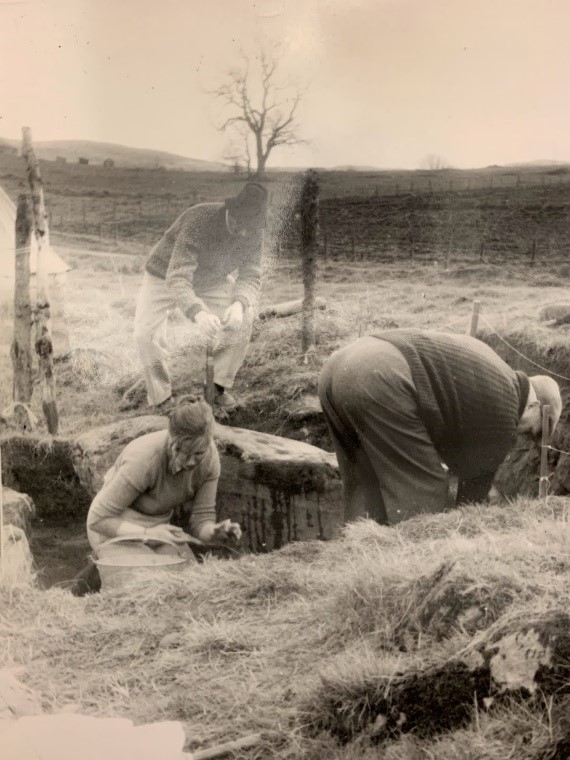
Margaret hoped ‘everyone had the thrill of unearthing cremated bone or a piece of pottery’. Indeed, the members ‘turned out in full force’ and worked hard to uncover a central cremation pit, human bone fragments, and a Bronze Age urn. The excavation was so successful it attracted national attention. The Weekly Scotsman reported how these ‘Aberfeldy amateurs’ were making archaeologists sit up all over Britain! Margaret herself praised the member’s fascination with discovering more about how people lived in their local area in prehistoric times.
In every excavation she directed, Margaret used her charm, whit, and passion to capture the interest of the local community. Margaret delivered numerous lectures, which she often introduced as a ‘chat’ to connect with members on a more personal level. Margaret also took her lectures from the classroom to the field! For instance, Margaret presented the urn found in the 1964 Carse Farm excavations on site to an interested audience of men, women, and children.
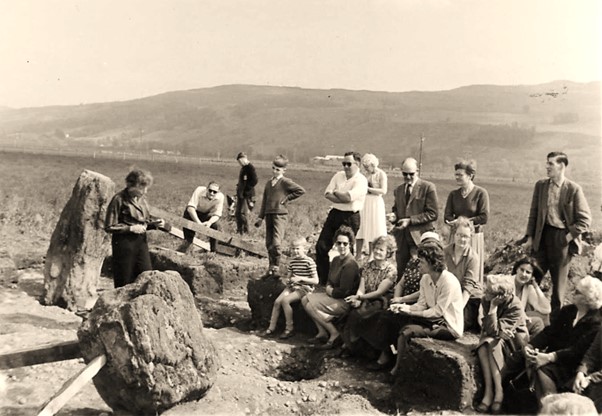
Margaret speaking at the Carse Farm Excavation, 1964
As director of excavation, Margaret used her projects, research, and publications to champion BHS’s aim of advancing research into the area’s prehistory, all while promoting local interest into Breadalbane’s past.
Margaret’s Legacy
It has been rather difficult to summarise Margaret’s contribution to BHS (and to Scottish archaeology more broadly) in only a thousand words. Nevertheless, this blog post has highlighted Margaret’s commitment to improving understanding of Breadalbane’s archaeological past, from being a source of inspiration to leading excavations across the region. At the same time, this blog post has demonstrated how the Bradalbane Heritage Society’s archive can be used as a springboard to understand Breadalbane’s rich history and the pioneering women who conducted this important research.
So, in Margaret’s own words, “more power to the shovels” and more power to the archaeological archive!
Amy Jo Kearton, University of Glasgow
 Breadalbane Heritage Society
You must be logged in to post a comment.