David has worked in archaeology at both national and local level in Wales, England and Scotland since the late 1980s. Over the last two decades with the Perth & Kinross Heritage Trust he has established the Historic Environment Record and planning archaeology service for Perth and Kinross. He has developed and delivered several projects including the Carpow logboat, Tay Landscape Partnership Scheme, Glenshee Archaeology Project and Kings Seat Archaeology Project. His areas of interest include community archaeology and, in particular, Iron Age forts and settlement c.700 BC to AD 700.
Membership: Thank you to all who have already paid their subscriptions either online or by cheque. There will be an opportunity to pay your membership subscriptions at the meeting, either cash or cheque, and it is not necessary to complete a new membership form unless your contact details have changed. We are not issuing membership cards this year, however all members will receive email confirmation of their membership and an electronic copy of the 2022-23 Programme, hard copies of which will also be available at the meeting. As in previous years, there will not be an entrance charge for BHS members, but visitors will be asked for a donation of £4 on the night.
Looking forward to seeing many of you at the Breadalbane Community Campus in Aberfeldy on Friday 21st October.
On Friday, 18th March 2022, Annette Carruthers, an Honorary Senior Lecturer at the School of Art History at the University of St. Andrews, presented her talk to the Breadalbane Heritage Society and described how, despite the tragic shortness of his life, James Marjoribanks MacLaren (1853-1890) achieved much in his architectural career and is recognised as a pioneer of the Arts & Crafts Movement. Annette discussed how his work as an architect and designer impacted on his contemporaries in the context of this movement in Scotland and in Britain more widely.
On Friday, 21st January 2022, John Borland presented his talk which provided an overview of the early medieval sculpture of Highland Perthshire, following its distribution from west to east along the glens and straths, highlighting what is rare and unusual. He examined the distribution of the sculpture to see what that tells us about its cultural origins and thus assess just how “Pictish” this part of Perthshire was.
John worked as an archaeological surveyor for the Royal Commission on the Ancient and Historical Monuments of Scotland and Historic Scotland (RCAHMS) and then Historic Environment Scotland (HES) for 36 years, latterly recording Scotland’s Pictish and other Early Medieval sculpture.
Wednesday, 6th July, 2022 tour of the Pictish stones in Fortingall Kirk and kirkyard led by John Borland.
Twenty members of the BHS gathered in Fortingall Kirk on 6 July to hear John Borland talk about the remarkably rich selection of fragments of carved stones displayed within the church and also outside. John is well known to many of our members, having previously given talks on the subject both at BHS meetings and at TAFAC conferences. He worked as an archaeological surveyor for the Royal Commission on the Ancient and Historical Monuments of Scotland for many years, the main focus of his work being the recording of Scotland’s Pictish and Early Medieval sculpture.
Before looking at and discussing the examples of the carved stones within the kirk and those in the courtyard, John talked about the history and development of sculptured stones in this area.
Some of the pieces of carved stones, dating to around 800 AD, were discovered during the demolition of the previous church in 1901, having been built into the walls of the church.
Their remarkably crisp carving, having been protected from the elements for many centuries, contrasts with the worn condition of some of the ancient grave slabs displayed against the walls of the church outside.
John pointed out that the stone on display on the north wall behind the pulpit, which is made up of three linked ringed crosses, is of a very rare type.
Other examples of three simply-incised crosses can be seen on one of the stones outside. Another stone is carved with what appears to be the folds of robes worn by angels or saints.
John observed that none of the finely carved stones were made from locally-obtained material but of a fine grey sandstone, which may have come from Strathmore and is similar to that of the Pictish cross slabs in the museum at Meigle.
Some of the recent additions to the magnificent assemblage of sculptured stones at Fortingall were discovered lying on the top of the Kirk’s boundary walls which had become exposed after the local council had cut back the creeping ivy from the walls.
After the talk, when a tour of the kirkyard was made, John made the interesting observation that the large natural boulder with a deep circular water-filled hole cut into it, which lies next to the porch, may not have been used as a christening font as we know it. It could, he said, have been on the ground beside the church entrance and been used for foot washing, or for the baptism of recently-converted adults where the person stood in the water for the ceremony.
Everyone who attended this talk and tour agreed that it had been a fascinating and informative morning, and we are very grateful to John Borland for yet again giving up his time to help us learn more about the rich cultural heritage of this area.
If you would like to view the talk, ‘The Early medieval Sculpture of Highland Perthshire’, which John presented to the Breadalbane Heritage Society on Friday, 21st January, 2022, you can view this here:
If you wish to view this video at a larger size, click on the ‘full screen’ button at the bottom right-hand corner of the image above:
A talk presented on Zoom by John Borland to the Breadalbane Heritage Society on Friday, 21st January, 2022.
In this talk, John gave an overview of the early medieval sculpture of Highland Perthshire, following its distribution from west to east along the glens and straths, highlighting what is rare and unusual. He examined the distribution of the sculpture to see what that tells us about its cultural origins and thus assess just how “Pictish” this part of Perthshire was.
John Borland worked as an archaeological surveyor for the Royal Commission on the Ancient and Historical Monuments of Scotland and Historic Scotland (RCAHMS) and then Historic Environment Scotland (HES) for 36 years, retiring as Measured Survey Manager in May 2020. In that time, John had the opportunity to survey almost every type of archaeological and architectural monument, from Neolithic chambered cairns to WWII coastal batteries and everything in between, including castles, churches, croft houses and country houses. However, the main focus of his work latterly was recording Scotland’s Pictish and other Early Medieval sculpture.
John has been a member of the Pictish Arts Society for more than 20 years and is the current PAS President.
You can view John’s talk here:
If you wish to view this video at a larger size, click on the ‘full screen’ button at the bottom right-hand corner of the image above:
This talk was presented on Zoom, but unfortunately due to the vagaries of local internet connections, John’s speech was disrupted in a number of occasions. However, the general content of his talk is still discernible during these instances.
Undeterred by the sightly damp weather which had followed several days of bright sunshine, sixteen members of the Society set out on the morning of 8th June to explore the lower eastern slopes of Schiehallion.
Group start at the Braes of Foss car park
Dr. Liz Auty, the Property Manager of East Schiehallion site which is owned by the John Muir Trust, acted as our guide. Liz is familiar to members of the BHS as a speaker, most recently on the subject of Neville Maskelyne, the Astronomer Royal, who between 1774 and 1776 conducted experiments on the mountain in an attempt to determine the density of the earth.
Liz introduction by Liz at the entrance information board
There was plenty to see along the tracks, with plentiful signs that these lonely slopes, now inhabited only by sheep and wildlife, had witnessed human activity for many thousands of years.
We stopped to examine a large cup-marked boulder near the track, the earliest record of human presence, dating back perhaps 5000 years.
Cup-marked boulder
Rather more recent is the site known as Fuaran Na H-Inghinn where the remains of several large long-houses, probably medieval, are barely visible under the layers of turf and heather, their stone walls having been robbed to build a sheep fank in the late 18th or early 19th century when a change of use of the land meant the mass introduction of sheep by landowners amid the infamous highland clearances. Other evidence of an earlier way of life can still be seen in the corn-drying kiln near the long-houses, now a sunken hollow.
Long house
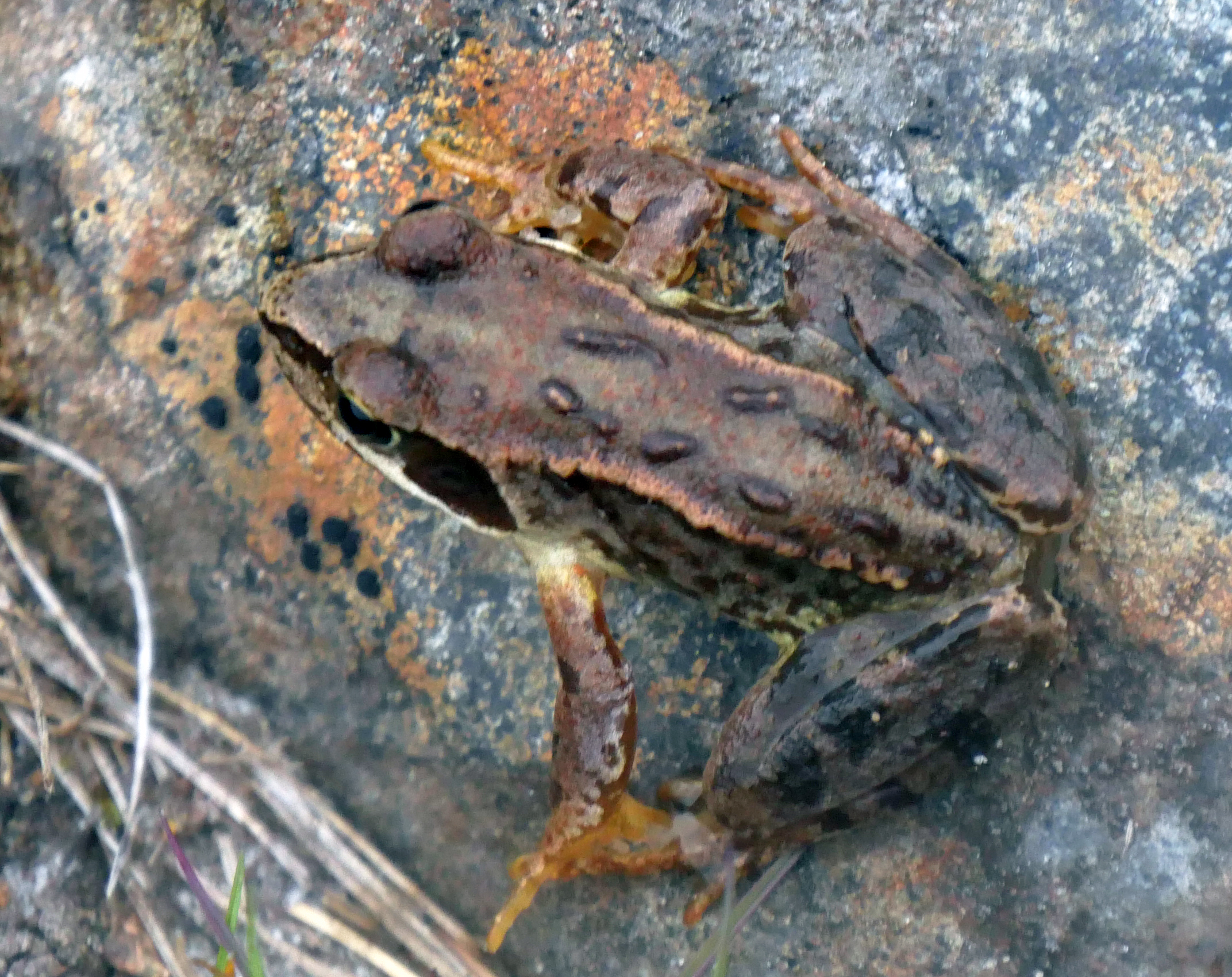
Common frogs
Along the way Liz pointed out various flowers: the rare Mountain Everlasting with its tiny furry blossoms, the bright blue of Common Milkwort and the starry white flowers of Chickweed Wintergreen, a localised plant here growing in profusion beside the track.
Mountain Everlasting with its tiny furry blossoms Bird’s-foot Trefoil and Common Butterwort
The starry white flowers of Chickweed Wintergreen
Few birds were to be seen except for a single Kestrel searching for prey and Whinchats perching on fence posts.
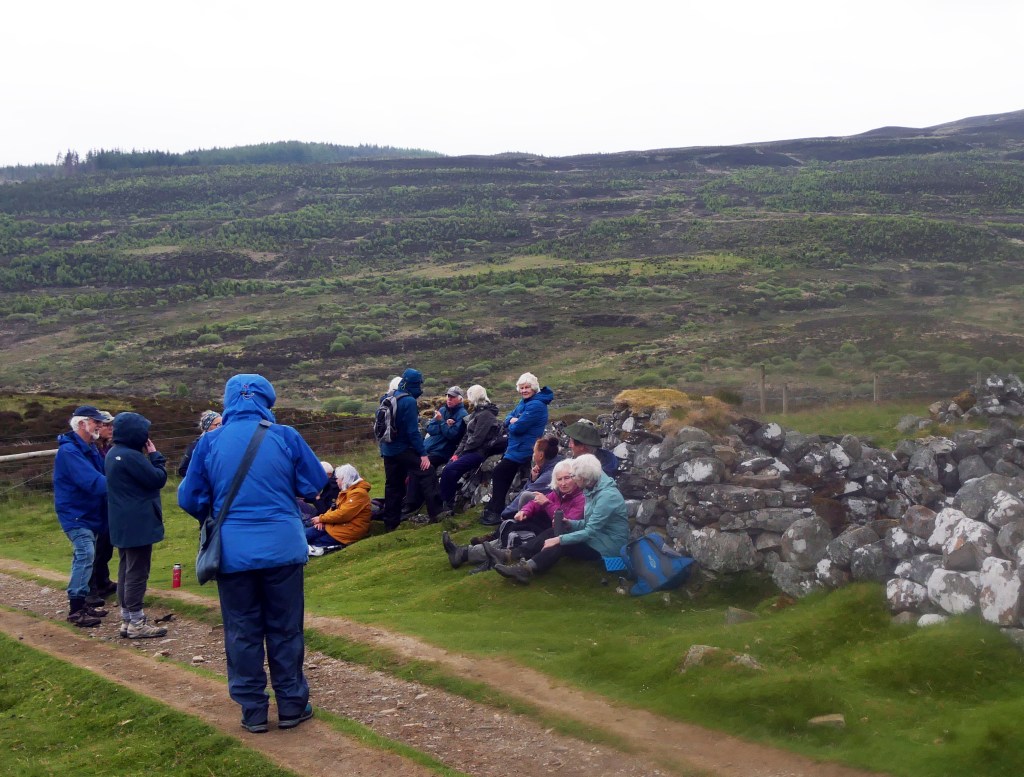
Coffee break at the sheep fank
After a pause for a welcome hot drink and snack beside the walls of the sheep fank . . .
Sheep shank
. . . the group continued upwards and into an area which has recently been fenced off to keep out deer and allow natural vegetation to grow; numbers of small birches, rowans and other species of trees are now appearing above the bracken and in time will become a forest.
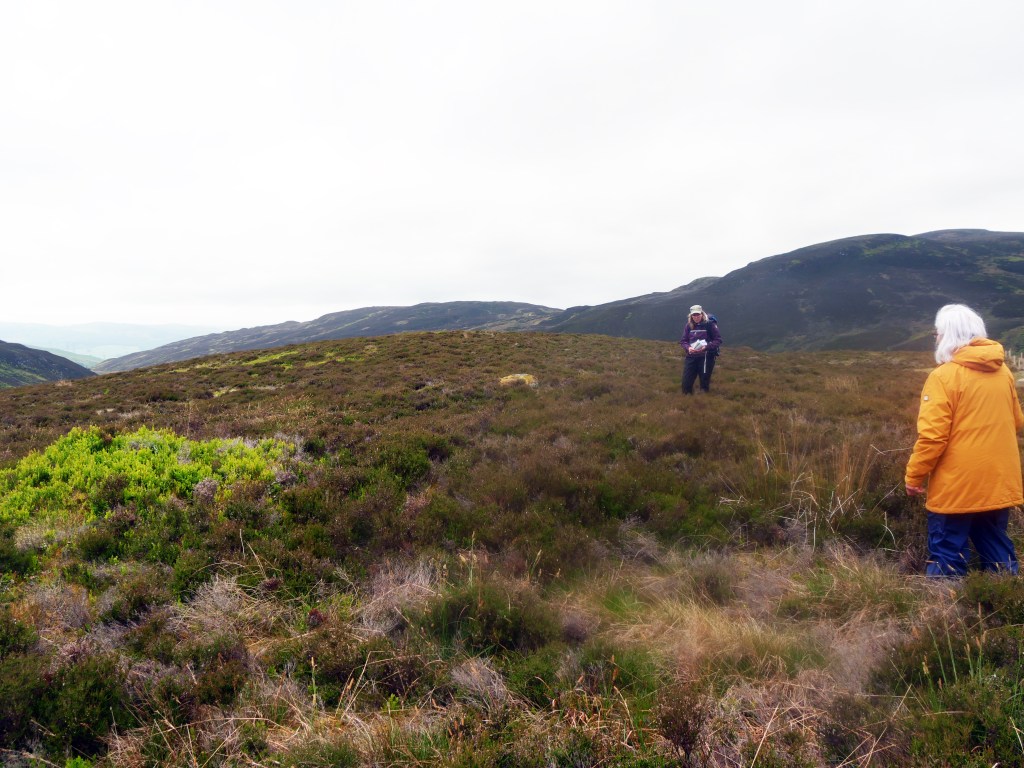
Our final archaeological site was a large hut circle, dating to the Late Bronze/early Iron Age, hardly visible now from the ground under the vegetation although, as Liz pointed out, these sites show up quite well in drone photos.
Hut circle area
Just visible on the horizon were two cairns, constructed at the time of Maskelyne’s experiments as aids to measurements, and now added to by walkers. We were now at around 400 metres above sea level and time did not allow for a visit to the observatory platform at 750 metres which will have to be kept for another visit.
Everyone agreed that it had been a most enjoyable tour and we are grateful to Liz Auty and of course to Ian Stewart for arranging the visit. If you would like to view the talk which Liz presented to the Breadalbane Heritage Society on Friday, 19th November, 2021, and learn more about the work of Neville Maskelyne, Astronomer Royal, and the John Muir Trust at their East Schiehallion site, you can view this here:
If you wish to view this video at a larger size, click on the ‘full screen’ button at the bottom right-hand corner of the image above:
Thanks for this review compiled by Fran Gillespie, and photographs provided by Lesley Whitwood and Ian Stewart
In what may be the Society’s first-ever offshore excursion, fourteen members visited the tiny island of Iona for three nights at the beginning of September last year. This long-awaited trip had been booked for September 2020 but had to be postponed due to Covid lock-down.
Based on our three-night stay there and on photographs taken at the time, we have compiled a short video of many of the places that we visited. If you have never been to Iona, hopefully this may encourage you to visit this beautiful, spiritual island.
Although Perthshire was part of Pictland, the corpus of Early Medieval sculpture in north-west or “Highland” Perthshire comprises very few Pictish stones. The prominence of simple crosses – linear, sunken and outline – which have their origins in the Scots’ kingdom of Dál Riata, suggests not only the spread of Christianity from the west but perhaps even gradual Scottish settlement.
In this talk, John Borland will give an overview of the early medieval sculpture of Highland Perthshire, follow its distribution from west to east along the glens and straths, highlighting what is rare and unusual. He will examine the distribution of the sculpture to see what that tells us about its cultural origins and thus assess just how “Pictish” this part of Perthshire was.
John Borland worked as an archaeological surveyor for the Royal Commission on the Ancient and Historical Monuments of Scotland and Historic Scotland (RCAHMS) and then Historic Environment Scotland (HES) for 36 years, retiring as Measured Survey Manager in May 2020. In that time, John had the opportunity to survey almost every type of archaeological and architectural monument, from Neolithic chambered cairns to WWII coastal batteries and everything in between, including castles, churches, croft houses and country houses. However, the main focus of his work latterly was recording Scotland’s Pictish and other Early Medieval sculpture. John has been a member of the Pictish Arts Society for more than 20 years and is the current PAS President.
To register for the talk and to receive the Zoom joining details, you must send an email to Ian at bhsaberfeldy@gmail.com.
In what may be the Society’s first-ever offshore excursion, fourteen members visited the tiny island of Iona for three nights at the beginning of September. This long-awaited trip had been booked at the St Columba Hotel in 2019 for September 2020 but had to be postponed due to lockdown last year.
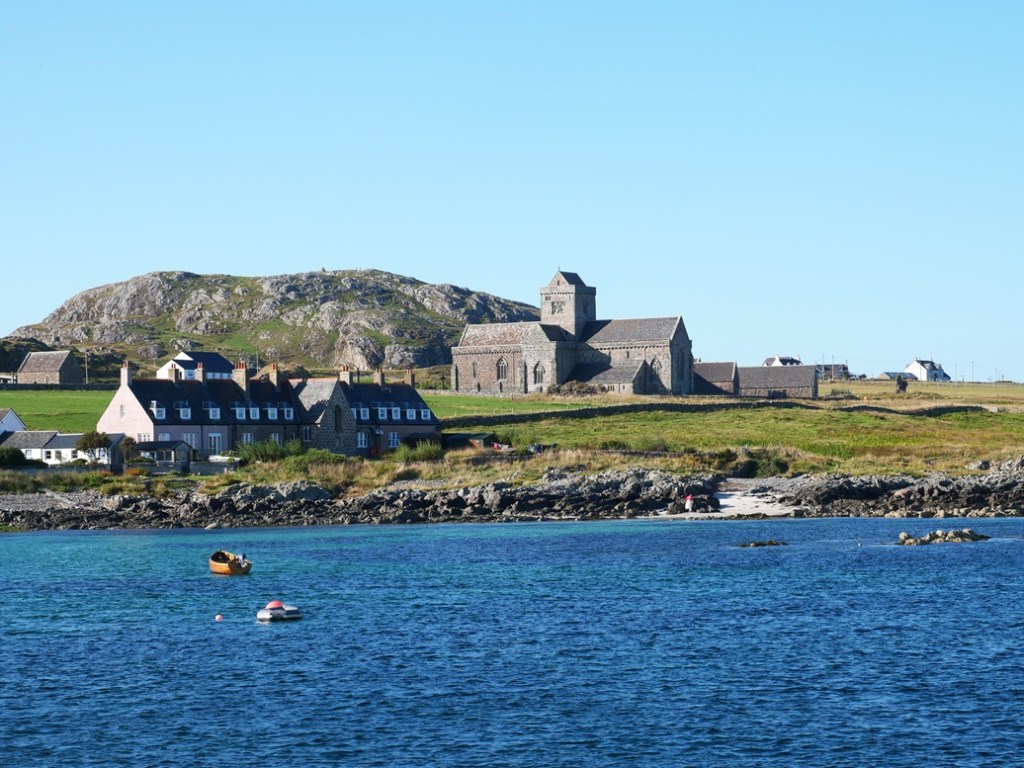
Iona Abbey with Dùn Ìin the background
Lesley Whitwood organised the three days with an ideal mixture of group activities and independent exploring. Some attended the services held nightly or in the morning by the Iona Community in the 12th century Benedictine abbey, and as a group we visited the wonderfully restored abbey buildings, its recently updated museum and the Nunnery and went for varied walks over the beautiful island scenery.
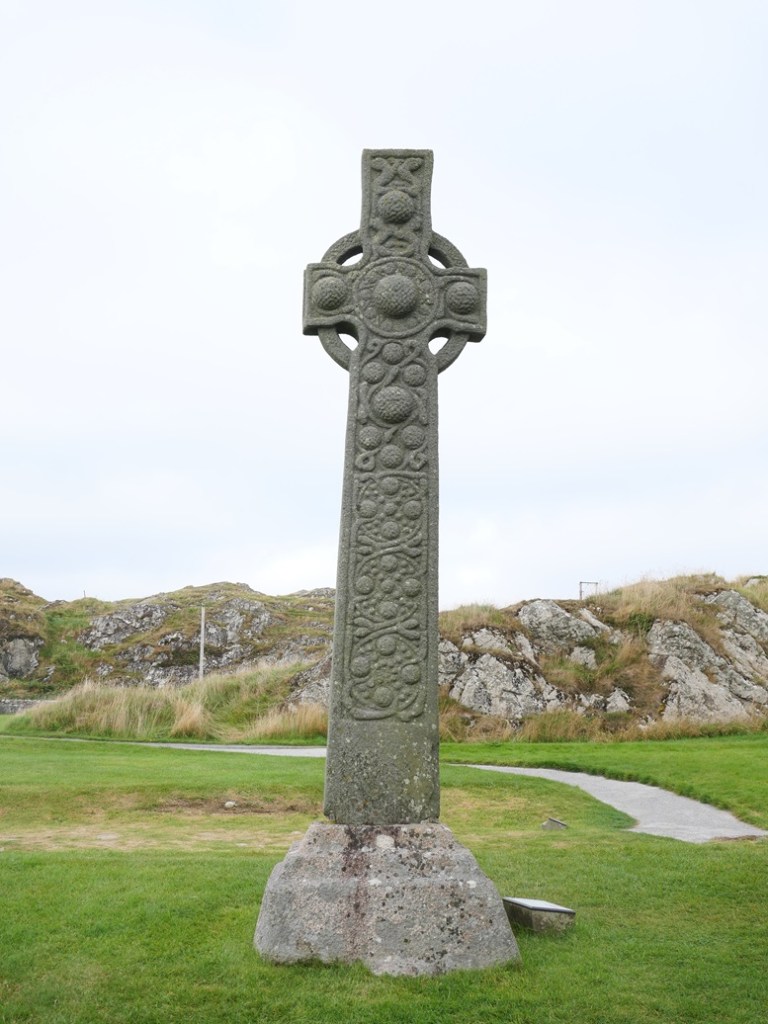
St. Martin’s Cross
We were blessed with warm weather, sometimes bright sunshine, sometimes cloudy, but thankfully not a drop of rain. Everyone agreed that, thanks to Lesley and to Sally Rose who undertook all the bookings, the trip was such a success that annual three-day excursions should take place – next year’s special multi-day trip to Angus is already in the planning.
After 18 months of Covid restrictions with all our 2020-21 winter programme of talks having been presented online by Zoom, we were hopeful that we would be able to present our new season of winter talks commencing in September 2021 ‘in person’ in our regular venue, the Breadalbane Community Campus in Aberfeldy. However, we were informed that public use of the main hall in the Breadalbane Campus complex would only be possible from the beginning of October. Consequently, our first winter talk on the 17th September was presented online using Zoom, but we were able to return to the Breadalbane Campus for our October talk. We are hopeful that the November and March talks will also still be able to take place in the Breadalbane Campus.
Taking into consideration the likelihood of adverse winter weather during the months of January and February making travel difficult and from comments and suggestions from our members that they are unwilling to venture out on cold, wet winter evenings, we have decided for this season to present the January and February talks online by Zoom. As we hold the talks on the third Friday of the winter months, there is not a talk in December as it would come very close to Christmas. Joining details for each Zoom meeting will be provided prior to each talk.
2021-22 Programme of Winter Talks
Friday 17th September 2021:Dr. David Summers – ‘The Atlantic Salmon’(by Zoom)
Friday 15th October 2021:Rob Hands – ‘Battles of the Three Muirs’
Friday 19th November 2021: Dr. Liz Auty – ‘The Attraction of Mountains, Schiehallion, ‘Weighing’ the World and Contour Lines’
Friday 21st January 2022:John Borland – ‘The Early Medieval Sculpture of Highland Perthshire’(by Zoom)
Friday 18th February 2022:Dr. Nicki Scott: ‘Ancient Magnificence: Arbroath Abbey and beyond’(by Zoom)
Friday 18th March 2022:Annette Carruthers: ‘James MacLaren and the Arts and Crafts Movement’
2022 Programme of Summer Excursions
In association with the programme of winter talks, we also run a short season of half and full-day excursions from late May to mid-July, ideally to locations referred to in some of the winter talks.
Amongst the locations we are currently considering are:
a full-day trip to visit Watling Lodge, Rough Castle Fort, Seabegs Wood and Castlecary Fort on the Antonine wall, led by Jim walker who presented an excellent informative talk to the Society on the Antonine Wall in November 2019;
a visit led by Dr. Liz Auty to look at the traces of the social and natural history evident on the the lower levels around Schiehallion;
a visit to the Duplin Moor and Tippermuir battlefields to the west of Perth, led by Rob Hand following his talk on these battles in October.
In addition, we are considering a three or four-day trip to Angus in late-August to visit a number of HES and other sites, some of which will be referred to in John Borland’s January talk and included in Dr. Nicki Scott’s February talk.
These are our preliminary excursion proposals and may be subject to change. Further details will be confirmed early next year.
Refer to the Events page for further information on the forthcoming season of Winter Talks.











 Breadalbane Heritage Society
You must be logged in to post a comment.