An illustrated talk presented by Colin Liddell to the Breadalbane Heritage Society on Friday, 17th November, 2023.
During the Covid lockdown, Colin, a long-standing supporter of, and a speaker to, the Breadalbane Heritage Society, researched and endeavoured to translate all of the Gaelic place names noted on maps within 175 square miles surrounding Pitlochry. He explained why and how he did this, and illustrated a number of fascinating features of the life carried on in the foothills of Highland Perthshire and beyond, which have been revealed through his translations.
You can view the video recording of his talk here: ‘Gaelic Map Names’, or by playing the video below. To view the video at the full size of your screen, click the ‘full screen’ button found at the bottom right hand side of the screen:
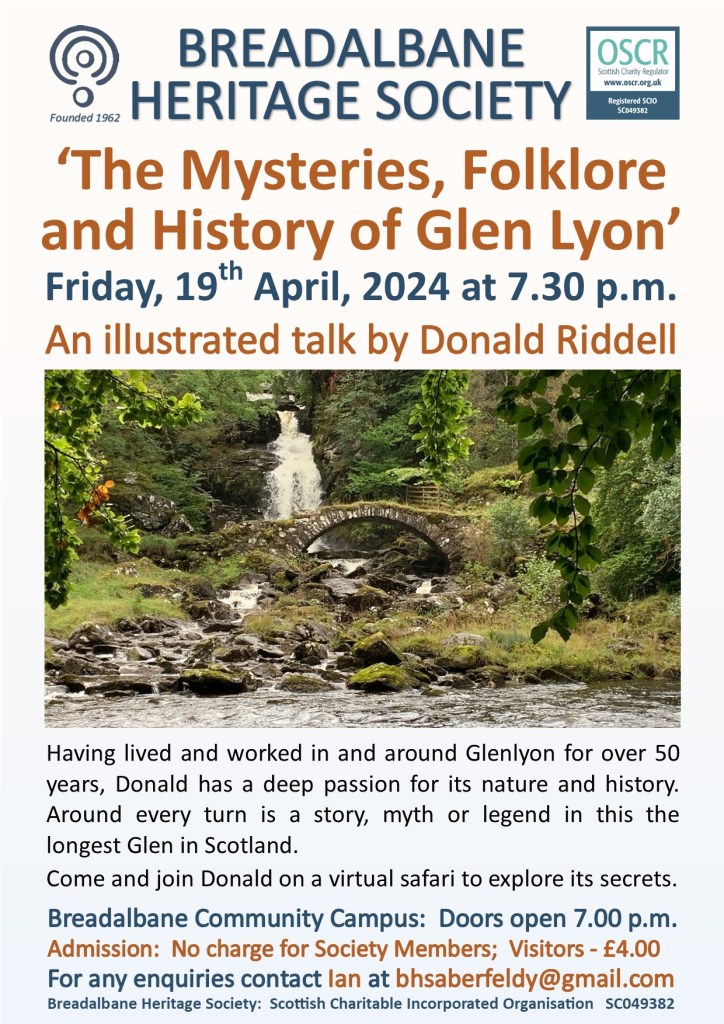
The next BHS Winter Talk takes place at 7.30pm in the Assembly Hall at the Breadalbane Community Campus on Friday 20th October, when Donald Riddell will be talking about “The Mysteries, Folklore and History of Glen Lyon”.
Looking forward to seeing many of you at the meeting on Friday, 20th October, for what should be a very interesting talk.
Professor Steve Boardman is the Professor of Medieval Scottish History at The University of Edinburgh with research interests in Late Medieval Scottish Kingship. His talk was based on his current research activities on the life and post-medieval mythologizing of the Wolf of Badenoch.
Friday, 21st October, 2022: ‘The Hillforts of the Tay’, presented by David Strachan
David Strachan is a Director of the Perth and Kinross Heritage Trust and his areas of interest include Iron Age forts and settlements c.700 BC to AD 700, and community archaeology. In this talk, he concentrated on the hill forts of Castle Law, Abernethy; Moncreiffe Hill, Bridge of Earn; and Kings Seat, Dunkeld.
Friday, 20th January, 2023: ‘Culloden’, Presented by Caitklin Greig
Caitlin is the Visitor Services Supervisor (Engagement) for the National Trust for Scotland at their Culloden Battlefield Visitor Centre. Her talk covered how the battle came about with the Jacobite supporters seeking to restore the Stuart monarchy to the British thrones, and how the current survey work carried out by the National Trust for Scotland on the site of the battle is changing the understanding of how the battle progressed.
Friday, 17th February, 2023: ‘Mar Lodge Estate Regeneration’, presented by Andrew Painting
Andrew is the Conservation Officer for the National Trust for Scotland at their Mar Lodge Estate to the west of Braemar. He is an upland ecologist with specialisms in native woodland restoration, bird monitoring and botany. His talk covered the work of NTS during the last 25 years and, in particular, to the advances made in regeneration in the last 10.
Friday, 21st April, 2023: ‘Discovering Froglife’s Scottish Projects’ presented by James Stead
James Stead is Froglife’s ‘Come Forth for Wildlife Project Manager’ and, in this talk, James aims to raise awareness of native reptiles and amphibians and will guide you to learn more about amphibians and reptiles in the area as well as the exciting work underway on the ‘Come Forth for Wildlife’ and ‘Fife Living Water’ projects.
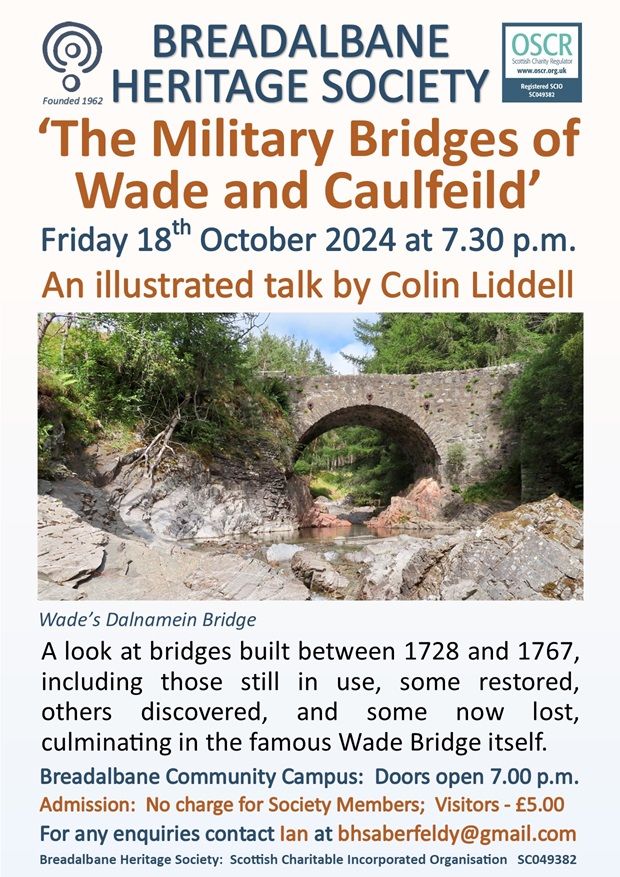
Old Ways and New Roads : Roads, Bridges, Landscapes and New Towns on the Highland Circuit 1720-1832
Christopher’s talk will look at the development of transport in the Highlands of Scotland between the building of the first military roads in the 1720s and the arrival of railways in the 1830s.
This was a period of rapid change in the Highland landscape, involving the building of bridges, the diversion of roads and the establishment of new settlements along the route followed by the ever-increasing number of tourists who followed a circuit through the Southern Highlands which took in the great designed landscapes associated with Inveraray Castle, Taymouth Castle, Blair Castle and Dunkeld House. Consideration will be given to the partnership which developed between landowners and the Government in these ventures.
With the help of archival material from the National Records of Scotland, particular attention will be paid to the impact of these developments on the Taymouth Castle estate.
After spending five years as an outdoor studies tutor at Kindrogan Field Centre in Strathardle, and ten years as Education Officer with the Dundee Museums and Art Galleries, Christopher Dingwall has worked for more than thirty years as an independent landscape historian and heritage consultant with a special interest in Scotland’s gardens and designed landscapes.
He is currently Vice Chairman of Scotland’s Garden and Landscape Heritage, having spent twelve years as Conservation Officer with the Garden History Society in Scotland from 1992 to 2004.
Among other things he was co-author of the report on the Taymouth Castle designed landscape, commissioned by Scottish Natural Heritage in 1996. He is author of a chapter in the book Old Ways New Roads : Travels in Scotland 1720-1832, published by Birlinn in 2021, on which this talk is based.
17 BHS members participated in the final BHS summer excursion for a 4-day trip to the Angus area to visit a number of archaeological and historical sites, predominantly owned by Historic Environment Scotland, from Monday the 22nd to Thursday the 25th of August.
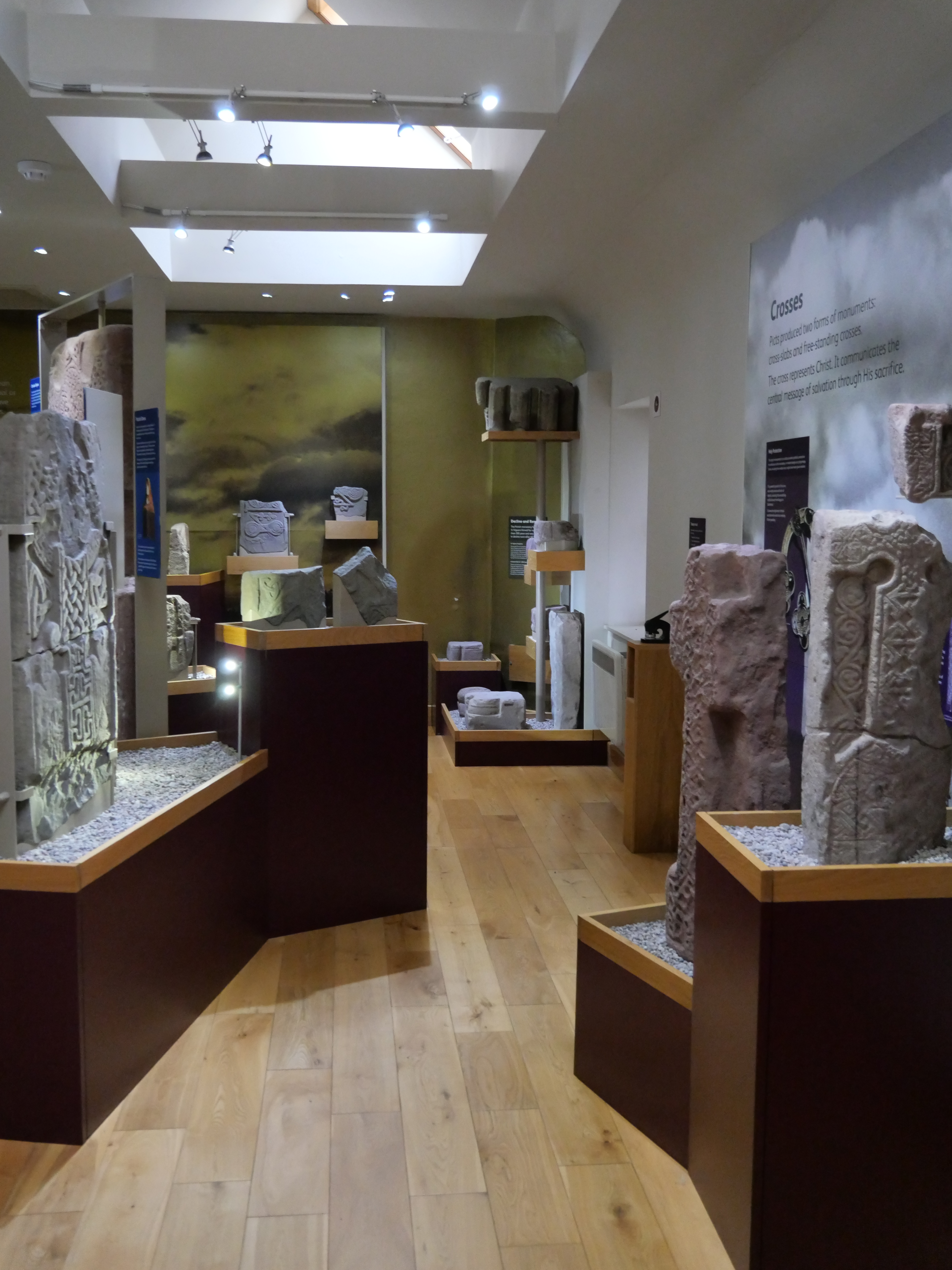
On the Monday, we visited the Meigle Sculptured Stone Museum, the Eassie Sculptured Stone and the four sculptured stones at Aberlemno before travelling to the George Hotel in Montrose, our base for the following days. We were very lucky that John Borland, who presented a talk on Medieval Sculptured Stones for us in January, was able and keen to join us for the day and to guide us through the meaning of many of the Pictish symbols.
Tuesday took us to Arbroath Abbey and the Arbroath Signal Tower Museum in the morning, and to the Scottish Wildlife Trust’s Montrose Basin Visitor Centre in the afternoon.
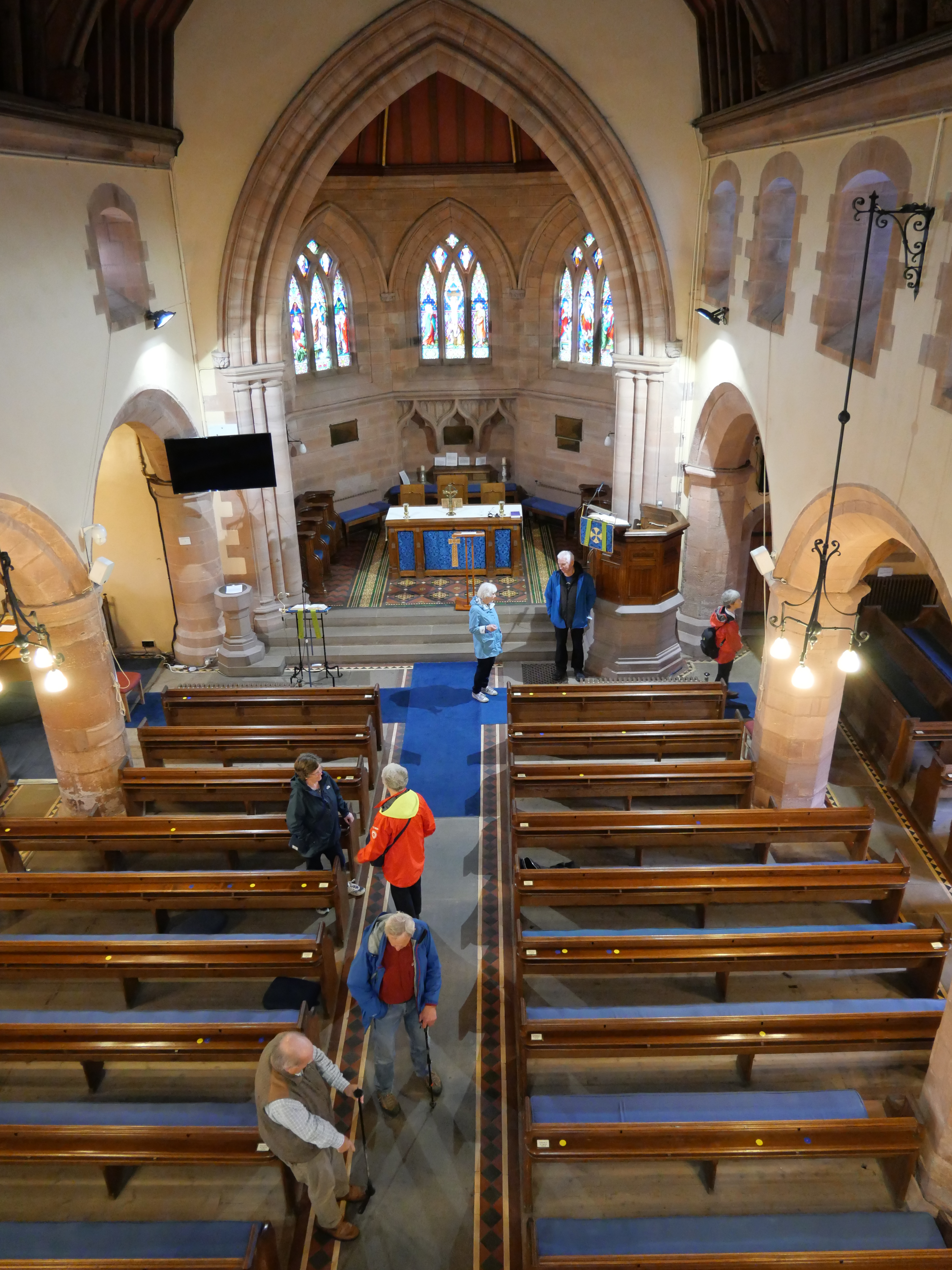
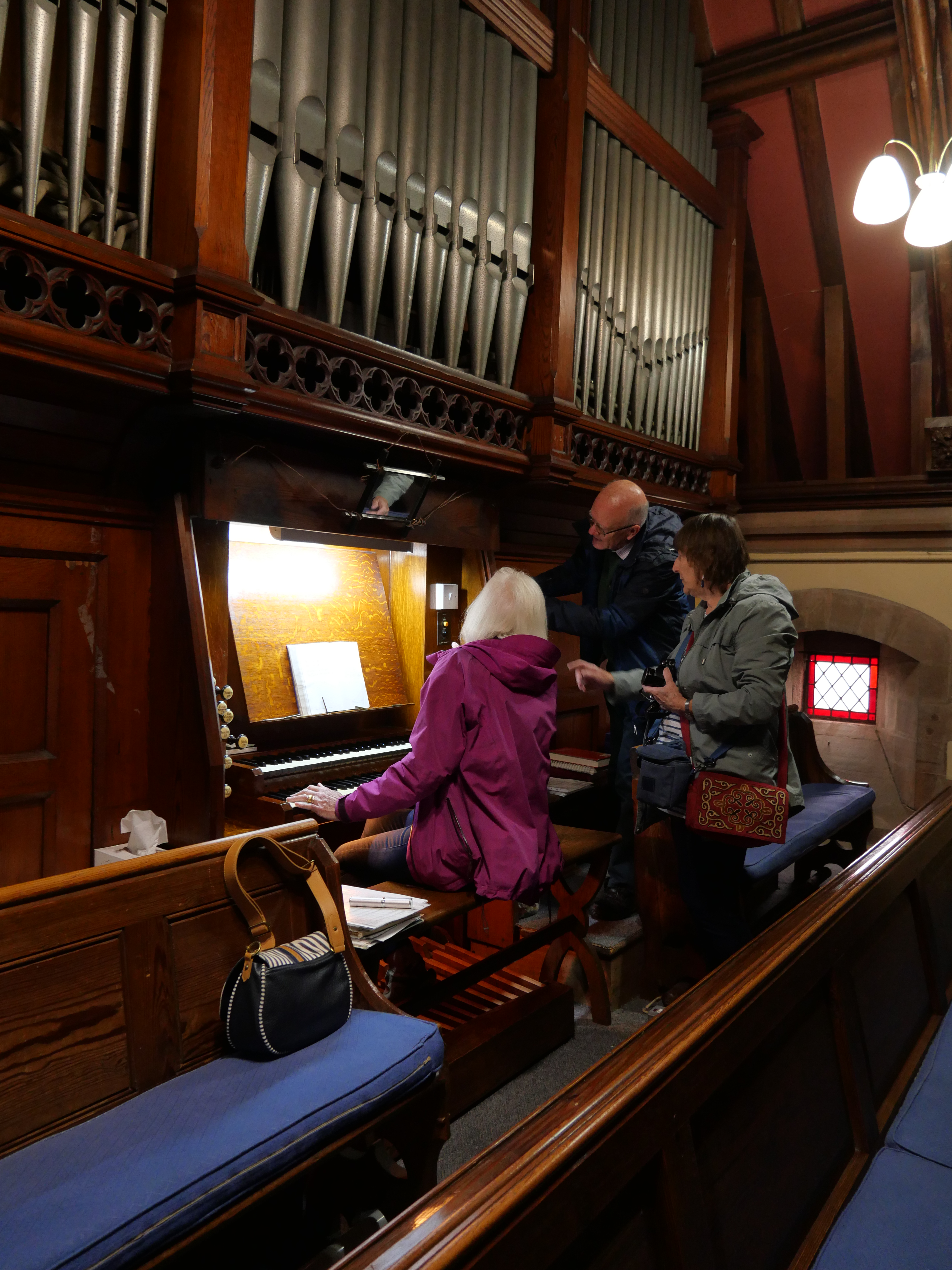
Further Pictish sculptured stones were inspected at the St. Vigeans Sculptured Stones Museum on Wednesday morning with a visit to the neighbouring St. Vigeans Parish Church before driving to Forfar to see more Pictish stones in the Meffan Institute Museum and Art Gallery.
On the final morning, we visited the National Trust for Scotland’s House of Dun and gardens just to the west of Montrose which included an informative and interesting guided tour of the interior of the house. In the afternoon, many of the fifteen members of the group managed to visit other sites on their way back to the Aberfeldy area which included the White and Brown Caterthun iron age hill forts to the north of Brechin and Restenneth Priory just to the east of Forfar.
If you would like further information on all the sites we visited, you will find a more comprehensive narrative with many more photographs on this page in our website:
On Friday, the 16th September, we open the new winter season of talks and events with a talk on Alexander Stewart, aka ‘The Wolf of Badenoch’. This starts a season which includes talks on ‘The Hillforts’ of the Tay’, ‘Culloden’, ‘The Regeneration of the Mar Lodge Estate’ and ‘Old Ways, New Roads’.
This opening talk on Alexander Stewart is presented by Steve Boardman, Professor of Medieval Scottish History at The University of Edinburgh, who is currently researching the life and post-medieval mythologizing of Alexander Stewart, Earl of Buchan, and a descendant of King Robert the Bruce.
Alexander Stewart is notorious as waging a rule of terror in the late 14th century in the Highlands and, in particular, the sacking of Forres, Pluscarden Priory and in Elgin the burning of Elgin Cathedral as well as the monastery of the Greyfriars, St Giles parish church and the Hospital of Maison Dieu. Through marriage and his royal connections, he had extensive lands in the Highlands as well as in the Breadalbane area at Bolfracks and Garth Castle.
In this talk, Steve will mostly concentrate on the Wolf’s posthumous reputation to the present day.
On Friday, 18th March 2022, Annette Carruthers, an Honorary Senior Lecturer at the School of Art History at the University of St. Andrews, presented her talk to the Breadalbane Heritage Society and described how, despite the tragic shortness of his life, James Marjoribanks MacLaren (1853-1890) achieved much in his architectural career and is recognised as a pioneer of the Arts & Crafts Movement. Annette discussed how his work as an architect and designer impacted on his contemporaries in the context of this movement in Scotland and in Britain more widely.
On Friday, 18th February 2022, Dr. Nicki Scott, Senior Cultural Resources Advisor with Historic Environment Scotland, presented her talk and described how although the survival of so many Pictish carvings highlights the long tradition of Christian worship across Angus, the tradition of monumental display continued in the medieval period, most famously at Arbroath Abbey. But while this royal foundation rightly draws much attention, sites such as Restenneth Priory and Maison Dieu show that it wasn’t just the elites whose lives were connected to the Church. Nicki provided some insight into the lives of these foundations and the people associated with them.
On Friday, 21st January 2022, John Borland presented his talk which provided an overview of the early medieval sculpture of Highland Perthshire, following its distribution from west to east along the glens and straths, highlighting what is rare and unusual. He examined the distribution of the sculpture to see what that tells us about its cultural origins and thus assess just how “Pictish” this part of Perthshire was.
John worked as an archaeological surveyor for the Royal Commission on the Ancient and Historical Monuments of Scotland and Historic Scotland (RCAHMS) and then Historic Environment Scotland (HES) for 36 years, latterly recording Scotland’s Pictish and other Early Medieval sculpture.
Wednesday, 6th July, 2022 tour of the Pictish stones in Fortingall Kirk and kirkyard led by John Borland.
Twenty members of the BHS gathered in Fortingall Kirk on 6 July to hear John Borland talk about the remarkably rich selection of fragments of carved stones displayed within the church and also outside. John is well known to many of our members, having previously given talks on the subject both at BHS meetings and at TAFAC conferences. He worked as an archaeological surveyor for the Royal Commission on the Ancient and Historical Monuments of Scotland for many years, the main focus of his work being the recording of Scotland’s Pictish and Early Medieval sculpture.
Before looking at and discussing the examples of the carved stones within the kirk and those in the courtyard, John talked about the history and development of sculptured stones in this area.
Some of the pieces of carved stones, dating to around 800 AD, were discovered during the demolition of the previous church in 1901, having been built into the walls of the church.
Their remarkably crisp carving, having been protected from the elements for many centuries, contrasts with the worn condition of some of the ancient grave slabs displayed against the walls of the church outside.
John pointed out that the stone on display on the north wall behind the pulpit, which is made up of three linked ringed crosses, is of a very rare type.
Other examples of three simply-incised crosses can be seen on one of the stones outside. Another stone is carved with what appears to be the folds of robes worn by angels or saints.
John observed that none of the finely carved stones were made from locally-obtained material but of a fine grey sandstone, which may have come from Strathmore and is similar to that of the Pictish cross slabs in the museum at Meigle.
Some of the recent additions to the magnificent assemblage of sculptured stones at Fortingall were discovered lying on the top of the Kirk’s boundary walls which had become exposed after the local council had cut back the creeping ivy from the walls.
After the talk, when a tour of the kirkyard was made, John made the interesting observation that the large natural boulder with a deep circular water-filled hole cut into it, which lies next to the porch, may not have been used as a christening font as we know it. It could, he said, have been on the ground beside the church entrance and been used for foot washing, or for the baptism of recently-converted adults where the person stood in the water for the ceremony.
Everyone who attended this talk and tour agreed that it had been a fascinating and informative morning, and we are very grateful to John Borland for yet again giving up his time to help us learn more about the rich cultural heritage of this area.
If you would like to view the talk, ‘The Early medieval Sculpture of Highland Perthshire’, which John presented to the Breadalbane Heritage Society on Friday, 21st January, 2022, you can view this here:
If you wish to view this video at a larger size, click on the ‘full screen’ button at the bottom right-hand corner of the image above:
You must be logged in to post a comment.