The October talk by Colin Liddell onย โThe Military Bridges of Wade and Caulfeildโย and the April talk by John Mattingley onย โCluny Gardens in the Springโย were recorded and can now be viewed below.
Colin Liddell who in the past has presented talks on General Wadeโs Scottish roads, concentrates this time on the bridges constructed by General Wade and his successor, Major William Caulfeild, who supervised the construction of many more roads and bridges than Wade.
The talk looks at military bridges built between 1726 and 1767, constructed by Major-General George Wade MP, โCommander of Forces in Northern Britainโ, and Major William Caulfeild, Chief Engineer, later โInspector of Roads in Scotlandโ, including those bridges still in use, some restored, others discovered, and some now lost, culminating in the famous ‘Wade Bridge’ itself in Aberfeldy. Watch here: โThe Military Bridges of Wade and Caulfeildโ
John started his talk with a short introduction on the history of Cluny and its gardens, and how it has developed and the future.
Spring is a glorious time at Cluny with carpets of North American bulbs and tubers in April while May brings colourful Candelabra primulas and wonderful blue Himalayan poppies. Watch here:https://vimeo.com/manage/videos/1083524454
Professor Steve Boardman is the Professor of Medieval Scottish History at The University of Edinburgh with research interests in Late Medieval Scottish Kingship. His talk was based on his current research activities on the life and post-medieval mythologizing of the Wolf of Badenoch.
Friday, 21st October, 2022: ‘The Hillforts of the Tay’, presented by David Strachan
David Strachan is a Director of the Perth and Kinross Heritage Trust and his areas of interest include Iron Age forts and settlements c.700 BC to AD 700, and community archaeology. In this talk, he concentrated on the hill forts of Castle Law, Abernethy; Moncreiffe Hill, Bridge of Earn; and Kings Seat, Dunkeld.
Friday, 20th January, 2023: ‘Culloden’, Presented by Caitklin Greig
Caitlin is the Visitor Services Supervisor (Engagement) for the National Trust for Scotland at their Culloden Battlefield Visitor Centre. Her talk covered how the battle came about with the Jacobite supporters seeking to restore the Stuart monarchy to the British thrones, and how the current survey work carried out by the National Trust for Scotland on the site of the battle is changing the understanding of how the battle progressed.
Friday, 17th February, 2023: ‘Mar Lodge Estate Regeneration’, presented by Andrew Painting
Andrew is the Conservation Officer for the National Trust for Scotland at their Mar Lodge Estate to the west of Braemar. He is an upland ecologist with specialisms in native woodland restoration, bird monitoring and botany. His talk covered the work of NTS during the last 25 years and, in particular, to the advances made in regeneration in the last 10.
Friday, 21st April, 2023: ‘Discovering Froglife’s Scottish Projects’ presented by James Stead
James Stead is Froglifeโs โCome Forth for Wildlife Project Managerโ and, in this talk, James aims to raise awareness of native reptiles and amphibians and will guide you to learn more about amphibians and reptiles in the area as well as the exciting work underway on the โCome Forth for Wildlifeโ and โFife Living Waterโ projects.
At short notice, we have added another, and final, Zoom talk to our 2022-23 winter season of talks and we invite you to attend this free, natural history Zoom talk on Friday, 21st April, at 7.30pm.
Froglife is a national wildlife charity committed to the conservation of the UKโs amphibians and reptiles in addition to the habitats these species depend upon. Froglife has been operating since 1989 with a number of national and regional projects.
They want to see people from all walks of life get involved in wildlife conservation and achieve this via three strands: on the ground conservation, environmental education / communication and research.
This presentation will enable you to learn more about amphibians and reptiles in the area as well as the exciting work underway by Froglife Scotland on the ‘Come Forth for Wildlife’ project and ‘Fife Living Water’ project.
To register for this talk and to receive the Zoom joining details, please contact Ian at bhsaberfeldy@gmail.com.
Zoom is free to download, and all are very welcome to participate in our Zoom meetings free of charge, although we do welcome donations from non-members; our members receive free โentryโ to all our winter talks. Please do encourage any friends or family who may be interested to join us, but they must register separately so that we are aware of prospective numbers attending as there is a permissible limit!
We look forward to “seeing” many of you on the evening of Friday, 21st April.
The past, present and future of the Caledonian pinewoods of Mar Lodge Estate NNR
Few landscapes in Scotland are as evocative or as celebrated as the Caledonian pinewoods. ย In these places, pines have survived uninterrupted since the ice retreated just over 10,000 years ago. ย These are landscapes of great ecological value, but they are also storied, mythologised, and even misunderstood. ย They have also suffered at human hands with just a few precious fragments remaining across the Highlands. ย
The pinewoods of Mar Lodge Estate NNR are no exception. ย These woods have risen and fallen over the centuries, and now are rising again, thanks to decades of work from dedicated people from all walks of life. ย In this talk, Andrew Painting, Conservation Officer with National Trust for Scotland and author of โRegeneration: the Rescue of a Wild Landโ, will delve into the past, present and future of Mar Lodge Estateโs pinewoods, and discuss what place they might have in a warming world.ย
Record 64lb salmon caught by Georgina Ballantine in the River Tay in 1922
On Friday, 17th September 2021, Dr. David Summers, the Fisheries Director of the Tay District Salmon Fisheries Board presented his talk which encompassed the life cycle of the salmon, the drastic reduction in salmon numbers and current scientific research studies. He provided an overview of the status of the River Tayโs salmon population and fisheries, with an emphasis on how things compare with the past and what the future might hold.
Undeterred by the sightly damp weather which had followed several days of bright sunshine, sixteen members of the Society set out on the morning of 8th June to explore the lower eastern slopes of Schiehallion.
Group start at the Braes of Foss car park
Dr. Liz Auty, the Property Manager of East Schiehallion site which is owned by the John Muir Trust, acted as our guide. ย Liz is familiar to members of the BHS as a speaker, most recently on the subject of Neville Maskelyne, the Astronomer Royal, who between 1774 and 1776 conducted experiments on the mountain in an attempt to determine the density of the earth. ย
Liz introduction by Liz at the entrance information board
There was plenty to see along the tracks, with plentiful signs that these lonely slopes, now inhabited only by sheep and wildlife, had witnessed human activity for many thousands of years.
We stopped to examine a large cup-marked boulder near the track, the earliest record of human presence, dating back perhaps 5000 years.
Cup-marked boulder
Rather more recent is the site known as Fuaran Na H-Inghinn where the remains of several large long-houses, probably medieval, are barely visible under the layers of turf and heather, their stone walls having been robbed to build a sheep fank in the late 18th or early 19th century when a change of use of the land meant the mass introduction of sheep by landowners amid the infamous highland clearances. Other evidence of an earlier way of life can still be seen in the corn-drying kiln near the long-houses, now a sunken hollow.
Long house
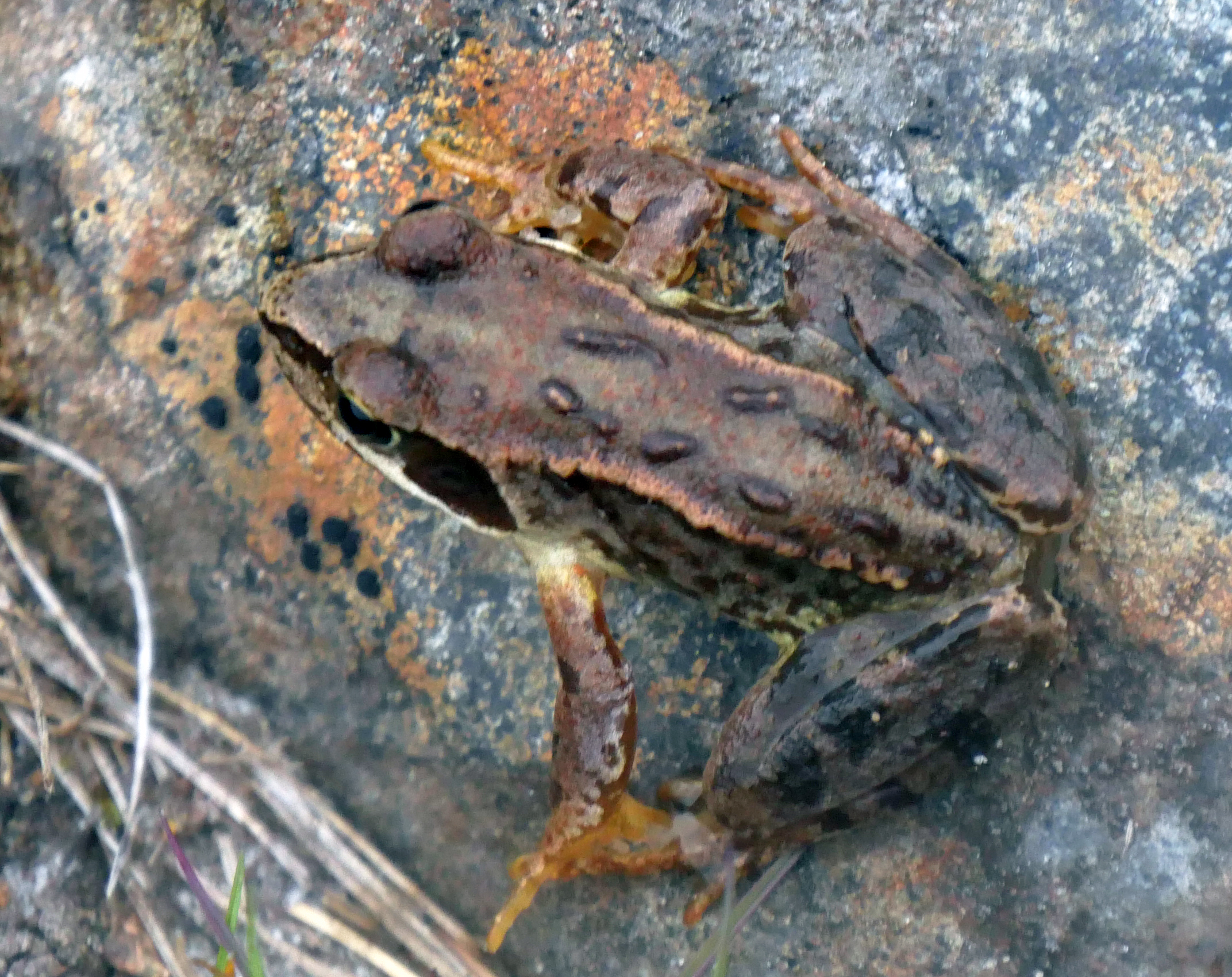
Common frogs
Along the way Liz pointed out various flowers: the rare Mountain Everlasting with its tiny furry blossoms, the bright blue of Common Milkwort and the starry white flowers of Chickweed Wintergreen, a localised plant here growing in profusion beside the track.
Mountain Everlasting with its tiny furry blossoms Birdโs-foot Trefoil and Common Butterwort
The starry white flowers of Chickweed Wintergreen
Few birds were to be seen except for a single Kestrel searching for prey and Whinchats perching on fence posts.
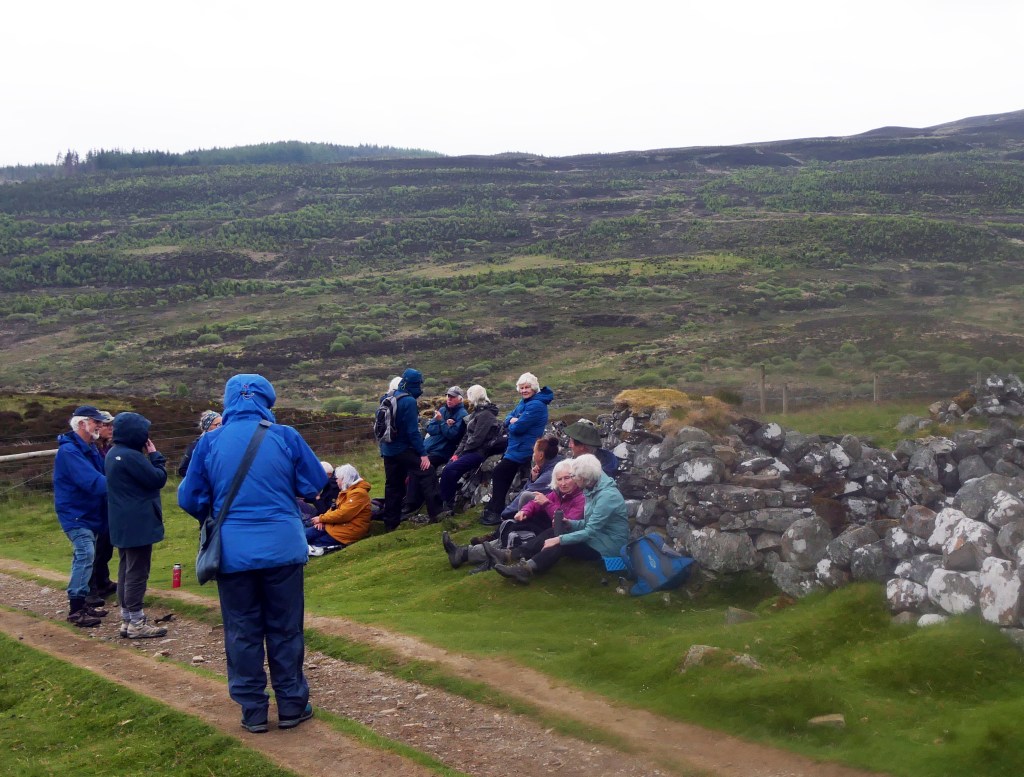
Coffee break at the sheep fank
After a pause for a welcome hot drink and snack beside the walls of the sheep fank . . .
Sheep shank
. . . the group continued upwards and into an area which has recently been fenced off to keep out deer and allow natural vegetation to grow; numbers of small birches, rowans and other species of trees are now appearing above the bracken and in time will become a forest.
Our final archaeological site was a large hut circle, dating to the Late Bronze/early Iron Age, hardly visible now from the ground under the vegetation although, as Liz pointed out, these sites show up quite well in drone photos.
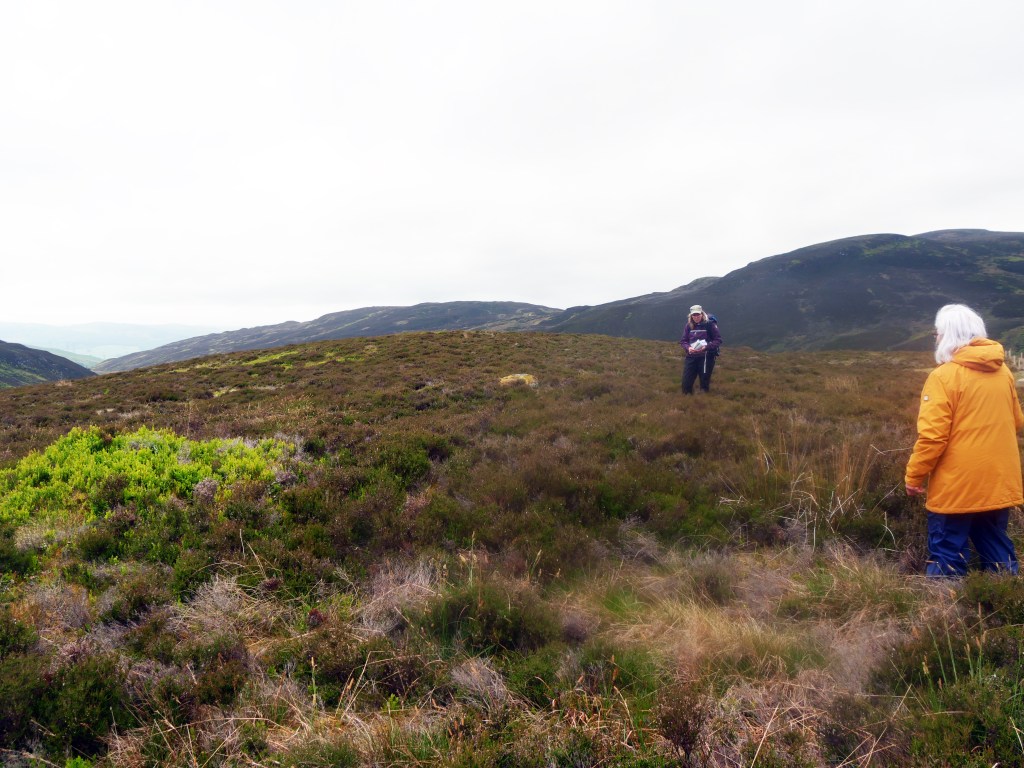
Hut circle area
Just visible on the horizon were two cairns, constructed at the time of Maskelyneโs experiments as aids to measurements, and now added to by walkers. We were now at around 400 metres above sea level and time did not allow for a visit to the observatory platform at 750 metres which will have to be kept for another visit.
Everyone agreed that it had been a most enjoyable tour and we are grateful to Liz Auty and of course to Ian Stewart for arranging the visit. If you would like to view the talk which Liz presented to the Breadalbane Heritage Society on Friday, 19th November, 2021, and learn more about the work of Neville Maskelyne, Astronomer Royal, and the John Muir Trust at their East Schiehallion site, you can view this here:
If you wish to view this video at a larger size, click on the โfull screenโ button at the bottom right-hand corner of the image above:
Thanks for this review compiled by Fran Gillespie, and photographs provided by Lesley Whitwood and Ian Stewart
Dr. David Summers is the Fisheries Director of the Tay District Salmon Fisheries Board and has over 30 yearsโ experience in the field of salmon and freshwater fisheries research and management.
On Friday, 17th September he opened our 2021-22 winter season of talks with a talk on talk entitled ‘Salmon and Salmon Fishing in the River Tay: Past, Present and Future’. Due to on-going Covid restrictions, we weren’t allowed to hold this talk ‘in person’ in our normal venue of the Breadalbane Community Campus in Aberfeldy, and presented it online on Zoom instead. 36 people registered for, and attended, this talk, of which 12 were non-members of our Society.
David’s talk encompassed the life cycle of the salmon, the drastic reduction in salmon numbers, current scientific research studies and findings, and local socio-economic benefits. David provided an overview of the status of the River Tayโs salmon population and fisheries, with an emphasis on how things compare with the past and what the future might hold. Particular emphasis was placed on issues local to the Breadalbane area such as hydro development.
Two versions of the recording of the talk are available to view. The first is approximately one hour long and contains just the talk. The second includes an additional subsequent 30-minute Q&A session providing further supplementary information. Both of these videos can be viewed below:
Full Talk with the Q&A session (90 minutes):
Only the talk (60 minutes):
If you wish to view these videos at a larger size, click on the โfull screenโ button at the bottom right-hand corner of the images above:
You must be logged in to post a comment.