My apologies for not being able to edit and upload the following talks until now, but we are now up to date – until our January Zoom talk comes along in eleven days!
Lying at the foot of Glen Lyon, the talk about the small community in Ardtrasgairt covers the changes in this working class community who lived there in the mid to late 19th century, and examines the effect of dramatic changes as industrialisation progressed. Watch here: ‘Ardtrasgairt – A potrait of a small Highland Community in the 19th Century’
Prehistoric rock art in Scotland is mostly known for its cupmarks, cup-and-rings and other circular imagery. In this talk Dr. Joana Valdez-Tullett discussed the results of Scotland’s Rock Art Project research in Loch Tay, and how carvings in this region relate to other areas in Scotland and the wider Atlantic façade. Watch here: ‘From Loch Tay to the Atlantic Façade‘
Invasive Non-Native Species (INNS) are a significant threat to our environments, native wildlife, economy, and in some cases to our health. The Scottish Invasive Species Initiative (SISI) is a project set up to tackle invasive non-native species, and Mark from SISI, will talk about the work he has done within the Esk & Tay catchment area and how invasive plants, particularly Giant Hogweed and Japanese Knotweed have been controlled. Watch here:‘Strategic Control of Invasive Non-Native Species in a River System’
The transformation of Aberfeldy from a few hovels to the smart town we know today, took place during the industrial revolution and was profoundly influenced by it. Alan Fisher, whose family has a history in the town spanning over 200 years, discussed Aberfeldy’s development with particular focus on the history of its wool, whisky and laundry industries. Watch here:‘Aberfeldy’s Industrial Revolution’
You can view these talks by using the links above for each one, but you can also access these by using the website “Recorded Winter Talks” page at https://breadalbane-heritage.org.uk/recorded-winter-talks/, which has links to all of the 28 recorded talks since September 2020. We were not permitted to record a few talks within this period which explains why there are some gaps in the winter season dates.
The Breadalbane Heritage Society have been maintaing the Killiechassie Burial Ground on and off since before 2010. Recently, they have installed two information boards at the inner burial enclosure.
The first board provides an introduction to the history of the Stewarts of Fothergill family.
The second board provides information on each of the graves situated within the inner burial enclosure.
The different QR codes on these boards provide links to different Killiechassie Burial Ground pages in this website which will provide more detailed information than is provided on the boards.
On Friday, 18th March 2022, and prior to the monthly meeting and talk commencing, the ‘Annual Members’ Meeting’ was held. As the Breadalbane Heritage Society is a registered Trust, this replaces the previous Annual General Meetings. If you were unable to attend the meeting, you can view the video recording here.
Breadalbane Heritage Society talk to be presented on Zoom on Friday, 18th February 2022 by Dr. Nicki Scott, Senior Cultural Resources Advisor at Historic Environment Scotland
The survival of so many Pictish carvings highlights the long tradition of Christian worship across Angus. But the tradition of monumental display continued in the medieval period; the most famous example of this is Arbroath Abbey.
Arbroath Abbey, courtesy of Historic Environment Scotland
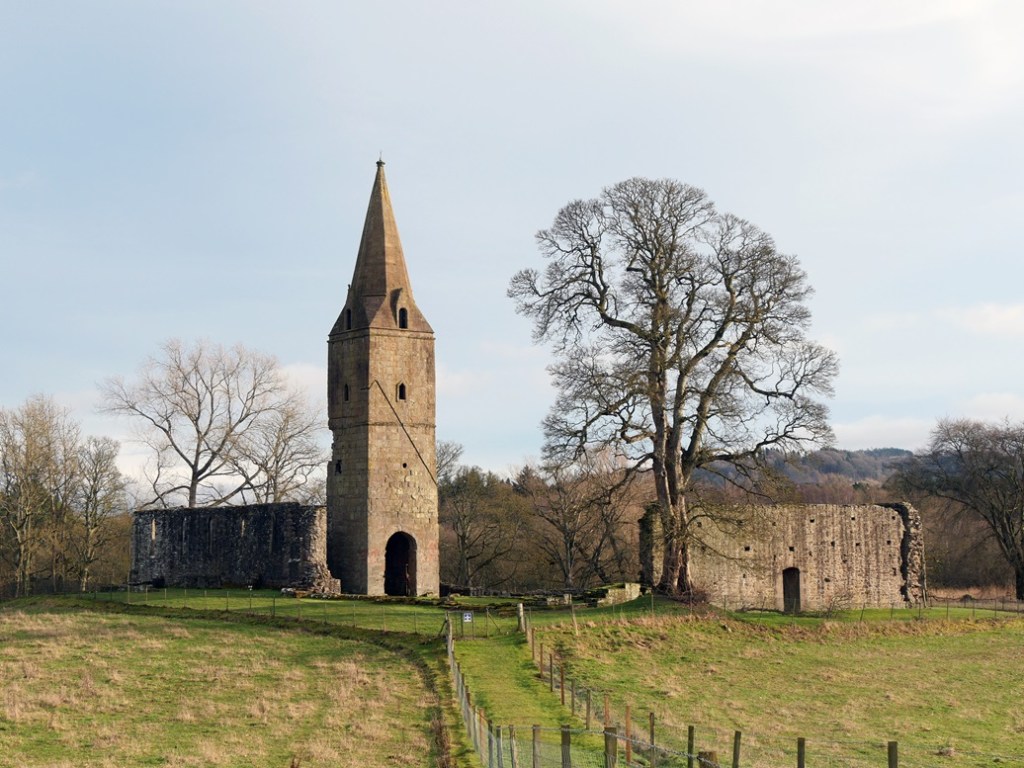
But while this royal foundation rightly draws much attention, sites such as Restenneth Priory and Maison Dieu show it wasn’t just the elites whose lives were connected to the Church.
Restenneth PrioryMaison Dieu Chapel
In this talk, Nicki will provide some insight into the lives of these foundations and the people associated with them. This talk follows on from last month’s talk by John Borland on ‘The Early Medieval Sculpture of Highland Perthshire’ but concentrates on the area of Angus.
Please note that, in order to obtain the Zoom joining instructions for this talk, you must contact Ian by email at bhsaberfeldy@gmail.com.
At last! Our first summer outing since July 2019! On the 9th June we held our first public summer visit of 2021 to the Menzies Mausoleum in the Old Kirk of Weem and to the Walled Gardens at Castle Menzies which includes the upper Archibald Menzies Garden. 12 members made up the party, which was limited in size due to Covid restrictions.
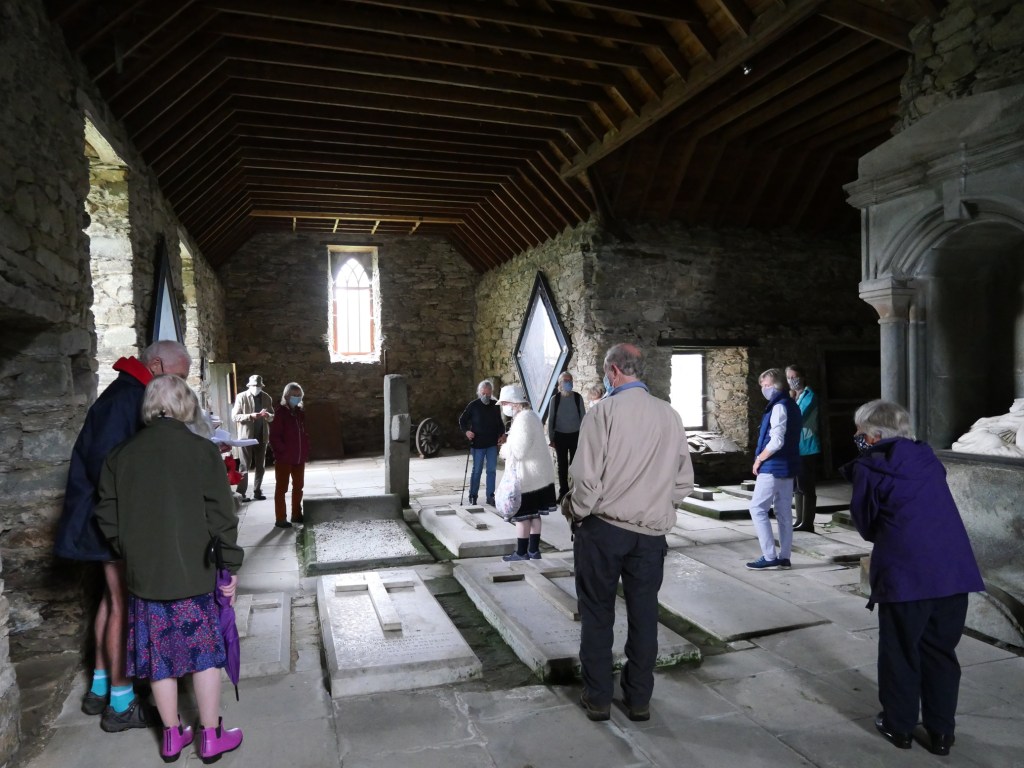
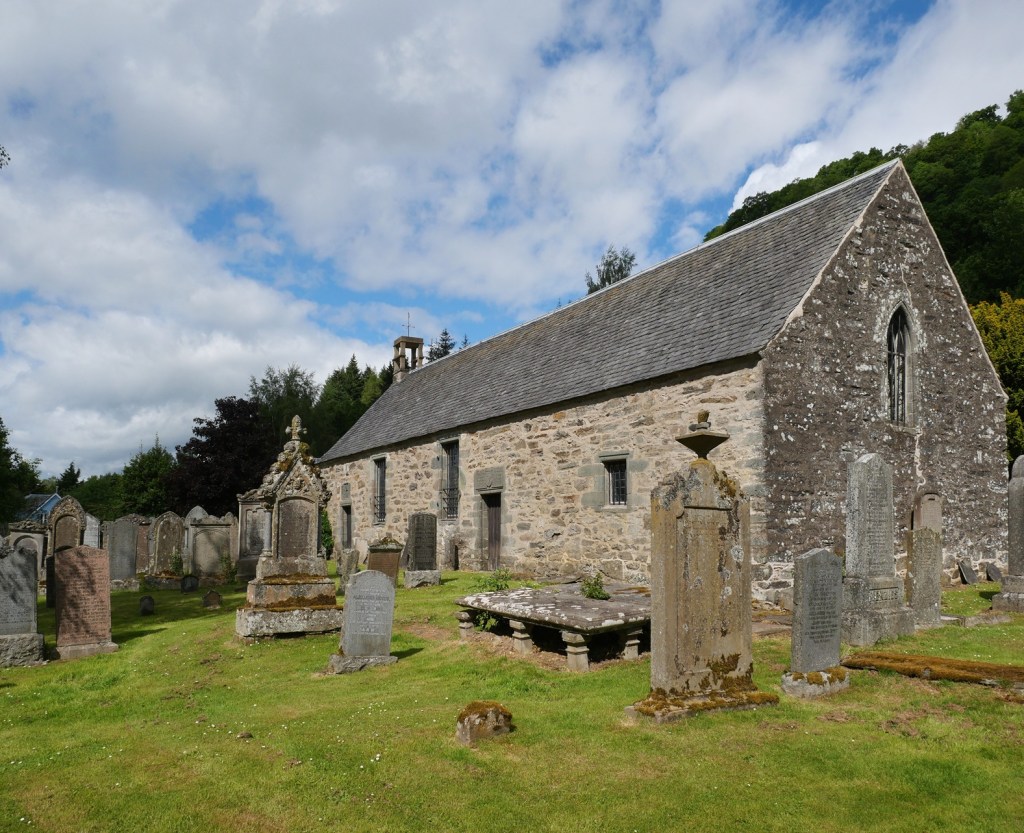
Menzies Mausoleum in the Old Kirk of Weem
Clare Thomas gave a splendid introduction to the Mausoleum which we then explored.
The party then went up to Walled Garden at Castle Menzies to learn from Fran Gillespie about its establishment and the way in which it has changed over the years.
Castle Menzies with the eastern edge of the walled garden to the rightThe walled garden viewed from the entrance road to the castleCongregating at the monumental gates to the walled gardenThe upper Archibald Menzies garden
How lovely it would be to have the garden restored to its former glory!
Overall, the visit to the Menzies Mausoleum and the Castle Menzies Garden was very successful particularly as many of the participants were new members. The offer of refreshments afterwards in the castle Tea Room with coffee and cake meant that our new members then had a chance to chat to others, form links and get to know each other. That was made easier by it being only a small group.
Now read on for further historical information on both the Old Kirk of Weem and the Castle Menzies Walled Garden.
Old Kirk of Weem – Menzies Mausoleum
According to tradition, the first church at Weem was established by St. Cuthbert around the year AD 650. Cuthbert founded an oratory and cistern at Chapel Rock (the Rock of Weem) above the village. The site was restored by Sir David Menzies around 1440 when he retired to live as a hermit there. The site was later renamed St. David’s Well after Sir David.
The first mention of Weem as a Parish is in Boiamund’s Taxatio, preserved in the Vatican. In this record, popularly known as Bagimont’s Roll, is set out a list of parishes and tithes collected from them in 1275 and 1276 by Boiamund de Vicci, Nuncio, sent out by the Pope to gather funds for the relief of the Holy Land. Listed is ‘Ecclesia de Weem, 30 sols’, giving revenue of ‘15 lib‘.
The church was under the patronage of the Earls of Atholl until 1464.
The early medieval building was replaced by the present building around 1488 by Sir Robert Menzies, the 8th Chief of Clan Menzies. An alternate version of events suggests that the church was built by John Menzies, the Clan Chief, after he was granted the Barony of Weem in 1451. Menzies family members were buried at Weem church from at least the 15th century.
The church was altered in 1609 and again in the 18th century. Given its links to St Cuthbert it is not surprising that the kirk was originally dedicated to him, but it was later referred to as St. David’s Church after Sir David Menzies (though he was never canonised). Neither dedication is used today and the church is simply referred to as the Old Kirk of Weem.
Inside the church are two large sandstone crosses brought here from the 8th century monastic settlement at Dull, a few miles to the west. They were part of a series of four stones that marked the sanctuary boundary of a Celtic monastery established by St Cuthbert. One of the other two stones can still be found in the centre of Dull village.
The Menzies Mausoleum at Weem was originally a simple rectangular stone church, probably thatched and dating to the late 15th century. Features of interest include the aumbries set into the wall with carvings above each, probably intended to hold holy water. In the post reformation period, the altar and chancel screen were removed and a pulpit then became the focus of the worshippers’ attention. Many structural alterations have taken place over the succeeding centuries, including raising the height of the roof and adding a gallery, now demolished.
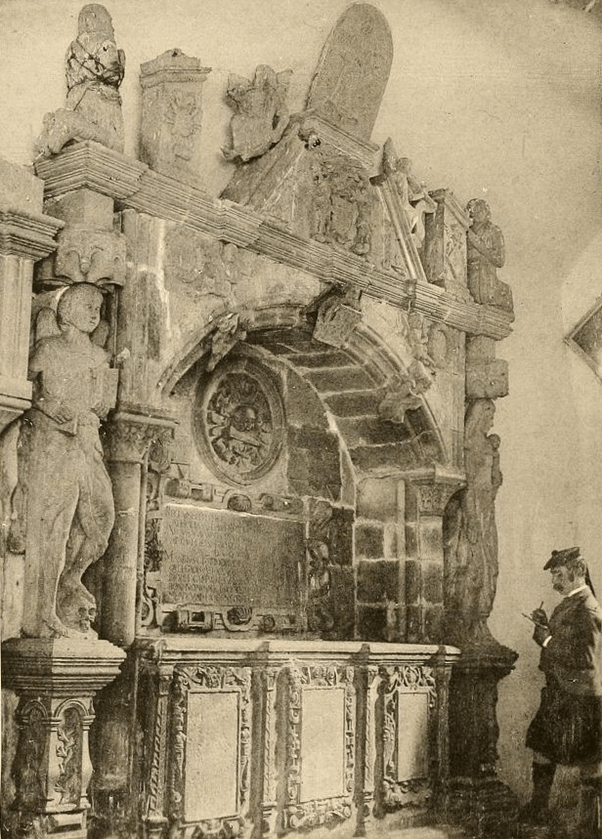
No longer in use as a church, the building houses a varied array of tombs and memorials of members of the Menzies clan, among which the most spectacular is the elaborately carved Menzies Monument, erected in 1616 by Sir Alexander Menzies as a tribute to his female ancestors.
Also of note is a large painted hatchment facing the visitors as they enter, with paper tears pinned to the edging, commemorating the sad death in 1845 of Caroline Elizabeth Menzies aged only 15.
Some Menzies clan members visiting the kirk, guided by Tommy Pringle, on the occasion of an annual clan gathering in August
Almost nothing is known about the earliest gardens at Castle Menzies, parts of which date to the 15th century. The first map that includes the castle and garden was drawn by Timothy Pont in 1595.
The garden was attached to the east side of the castle and shows four rectangles divided by paths, trees and walls, with woods and orchards to the north and west.
After that there is no evidence until the early 1700s when receipts for gardening equipment and staff wages appear in the archives. A receipt dated 1735 is for an extensive list of 45 different vegetable seeds and two ‘English’ spades. But it is not known where this large vegetable garden stood except that it was probably still attached to or near the east wall of the castle. In the second half of the 18th century, kitchen gardens tended to be moved away from dwellings at least in part because of the smell of the fresh manure used to create the heat required for melons and cucumbers.
The first walled garden is referred to in a letter written in 1790, the drainage ditches which surrounded it are still visible in the field to the east of the castle, and part of its east wall still survive. The noted plant hunter Archibald Menzies [1754-1842] worked along with two of his brothers in the castle gardens, where his father James was head gardener; it’s possible that this is the garden he knew.
The present walled garden is mentioned in a letter of 1838, with its south wall being the north wall of the earlier walled garden. It consists of three levels on a steep slope, connected by stone stairways and divided by high walls, and the topmost tier is dedicated to the memory of Archibald Menzies (the Archibald Menzies Garden) and contains several trees discovered by him. A fine mature example of one of his most famous discoveries, the Pacific Madrone (Arbutus menziesii), stands just outside the western wall of the gardens.
Central steps and stairway linking all levels
More information, including recent attempts to reclaim and improve the gardens, can be found in the following websites:
There are continuing discussions regarding the possibilities for its future care and development.
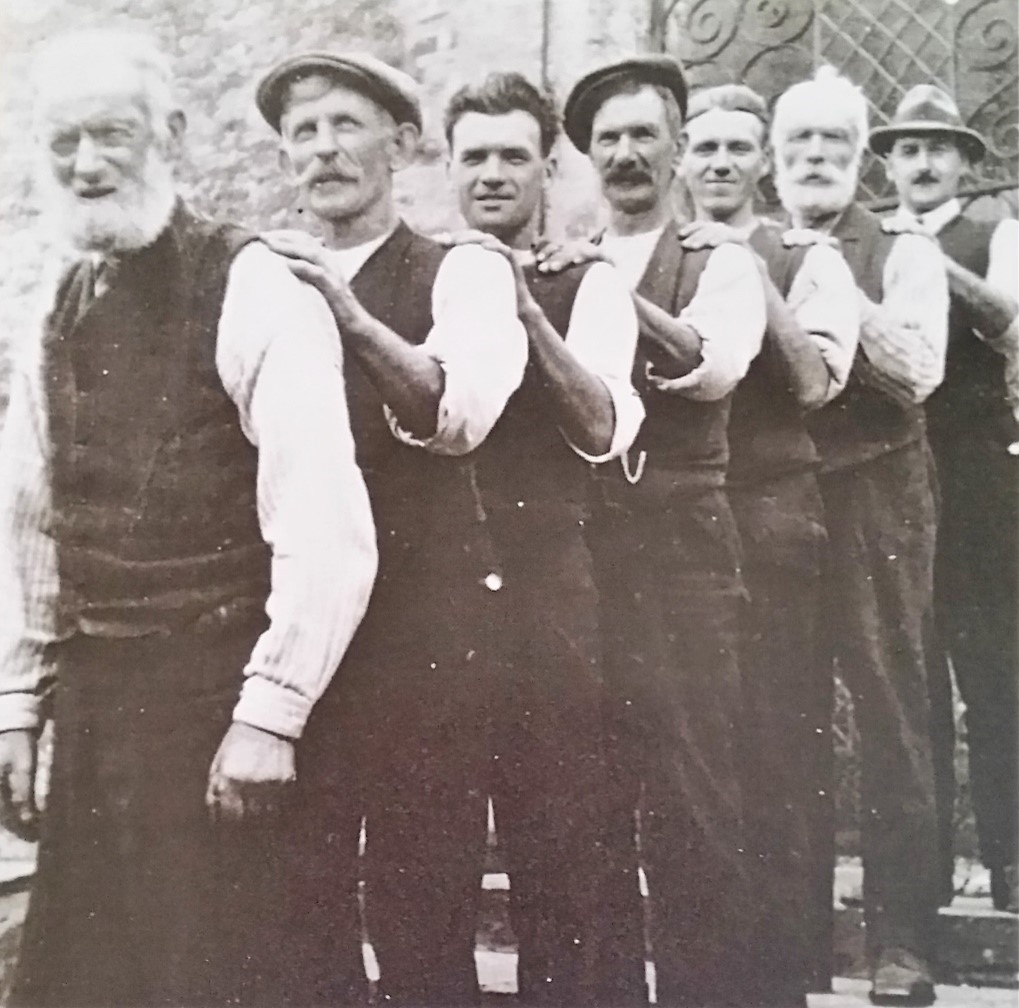
The seven Gardeners at the Gates of the Walled Garden Castle Menzies, circa 1920
Left to right:
Sandy McGregor, (lived in the South Lodge); Archie McNaughton (Dull); Bobbie Connell, (lived at the Middle Lodge with his father who was the Lodge Keeper); Jimmie Campbell, (lived latterly at Dull); Next one – unidentified; Sandy McIntosh, of Milton; Aldrid ?, the Head Gardener.
Lesley Whitwood, Fran Gillespie, Ian Stewart and Tommy Pringle contributed to the above text and photographs.
Just a reminder that our next Zoom talk takes place this Friday, 20th November, at 7.30 p.m. when Helen Stewart will be talking about “Researching your Family History in Scotland“.
Helen will show you how to use “Ancestry” and “ScotlandsPeople” to search births, marriages, deaths, censuses and other records, indicating the range of information that is available and what to expect when you start to search.
She will touch on the rest of the UK and Ireland and take a brief look at the rest of the world as so many of us have ancestors who emigrated.
Her talk will include some suggestions for searching newspapers, gravestones and other useful websites, such as searching armed forces’ websites, and she will give you some tips and advice.
For joining details, or for further information, please contact Ian Stewart at bhsaberfeldy@gmail.com.












 Breadalbane Heritage Society
You must be logged in to post a comment.