
Digging in the Archives for Margaret E C Stewart: The Contribution of Women to Scottish Archaeology in the Twentieth Century
Researched and presented by Amy Jo Kearton

The author holds copyright over this paper and should be consulted at Amy Jo Kearton by any party wishing to make use of her work.
Abstract
To ignore women in the history of archaeology is to suggest they did not contribute to the discipline. This article adds to the emerging historiography focused on uncovering the contribution of women to Scottish archaeology with an assessment of Margaret E C Stewart’s education, career, and public work. The different strands of material held across local archives, archaeological organisations, and online have been pulled together to form a connected understanding of Margaret as a woman and archaeologist. This study has aimed to understand the challenges Margaret faced and her strategies to become a respected professional in Perthshire archaeology, including her engagement with the community, female archaeologists, and archaeological societies. Although focused on one woman, this paper has contributed to identifying wider cohorts of female archaeologists in twentieth-century Scotland by situating their careers in the discipline’s history.
Key Words: Professional female archaeologist; Perthshire; Scotland; Society of Antiquaries of Scotland; excavation; administration.
Acknowledgements
I wish to express my gratitude to a number of people for helping me complete my dissertation over the past year.
First and foremost, I would like to acknowledge my deepest appreciation for my supervisor, Dr Catriona MacLeod, for the opportunity to complete an applied dissertation and her invaluable guidance and patience throughout.
Kate Bailey and Sally Pentecost for being wonderful placement supervisors and everyone at the Society of Antiquaries of Scotland for making placement a most enjoyable experience.
I was fortunate to have help from various local archives and archaeological societies, specifically Perth and Kinross archive, Edinburgh University Archives, and Special Collections at Glasgow University, with special thanks to Breadalbane Heritage Society for kindly loaning valuable material.
Finally, I would like to thank my close friends and family for their unwavering support and constant motivation, especially my parents Eddie and June and sister Ellie for proofreading countless drafts.
List of Figures
Chapter 1
Figure 1.1 – Margaret graduating from Edinburgh University (1930).
Figure 1.2 – Margaret Crichton Mitchell measuring the Souterrain at Castlelaw Fort (1932).
Chapter 2
Figure 2.1 – Margaret E C Stewart on her Wedding Day (1936).
Figure 2.2 – Plan of Monzie Stone Circle (1939).
Figure 2.3 – Breadalbane Heritage Society members excavating Lundin Farm (1963).
Chapter 3
Figure 3.1 – Margaret E C Stewart Showing the Public the Carse Farm Excavation (1964).
List of Tables
Chapter 1
Table 1.1 – Excavations Margaret Crichton Mitchell participated in with the Edinburgh League of Prehistorians.
Chapter 2
Table 2.1 – Expenditure for 1963 excavation of Lundin Farm.
Abbreviations
MECS = Margaret E C Stewart, born Margaret Enid Crichton Mitchell.[1]
APAAA = Archaeological Papers of the American Anthropological Association
SoASct = Society of Antiquaries of Scotland
PSAS = Proceedings of the Society of Antiquaries of Scotland
EUA = Edinburgh University Archives
UoE = University of Edinburgh
ELP = Edinburgh League of Prehistorians
TELP = Transactions of the Edinburgh League of Prehistorians
PELP = Proceedings of the Edinburgh League of Prehistorians
BHS = Breadalbane Heritage Society
BHSA = The Archives of Breadalbane Heritage Society
PSNS = Perthshire Society of Natural Science
TPSNS = Transactions of the Perthshire Society of Natural Science
PKA = Perth and Kinross Archive
SRGBA = Scottish Regional Group for British Archaeology
DES = Discovery and Excavation Scotland
TFAJ = Tayside and Fife Archaeological Journal
Contents
Chapter 1 – Early Life and Education
Chapter 3 – Public Archaeology and Societies
Appendix A: Margaret E C Stewart’s Publications List
Appendix B: Table of Projects Directed or Co-Directed by Margaret E C Stewart
Appendix C: Margaret’s Roles in Archaeological Organisations
Appendix D: Women in Scottish Archaeology Mentioned Throughout this Paper
According to Levine, one of the most formidable barriers to examining histories of female archaeologists is the common misconception that women were not present in archaeology until recently.[2]In the context of twentieth-century Scotland, there are numerous female archaeologists ready to be excavated from the archaeological record. For example, Dr Margaret E C Stewart, one of Perthshire’s most recognised archaeologists. Nevertheless, more digging in local archives was required to understand her archaeological contributions.
The late twentieth-century movement from women’s to gender history encouraged the expansion of literature regarding female archaeologists. A key proposition was women must be integrated into traditional histories of archaeology. Within this broader theme, several scholars have used a biographical approach to challenge androcentric assumptions about women’s absence. Cohen and Joukowsky showed how archaeology’s professionalisation impacted twelve female archaeologists from 1850-1950, alongside how these women shaped the nascent discipline.[3] Similarly, Hamilton, Whitehouse, and Wright contributed three biographical papers to recover the value of early female archaeologists.[4] This literature has validated histories of female archaeologists and positioned women within the discipline’s historiography.
Individual biographies have added nuance to the use of gender theory in histories of female archaeologists. Carr asserted Tessa Verney Wheeler’s career should not be predetermined by gender theory.[5] Gilchrist disagreed and observed gender theory can help recognise how perceived gender differences influenced women’s archaeological experiences.[6] Pope proposed ‘gender archaeology’ as a middle ground to understand social norms through the evidence, not the backward projection of twentieth-century patriarchal conventions.[7] Therefore, awareness of how gender constructs may have affected Margaret’s capability will make gender more visible in the archaeological archive.
Stig Sorensen identified two types of research into female archaeologists.[8] The first examined individuals as role models and highlighted their unique achievements. For example, Carr portrayed Tessa as representative of an ‘early excellent woman archaeologist’.[9] However, such research has typically glossed over the disciplinary challenges women faced. Conversely, the second method focused on women’s marginalisation in the field. Contrary to the typical biography, Browman adopted a more egalitarian approach to rescue women from obscurity in Americanist excavation reports, journals, and archaeological associations.[10] Browman avoided cherry-picking the best-known female archaeologists and uncovered over 200 women, which busted myths of their archaeological absence. This paper has fused these methods by analysing the challenges Margaret faced, alongside her strategies to form a successful career. Focus on one-woman risks overlooking the broad swath of female archaeologists in Scotland. Margaret did not have a separate identity from her female contemporaries. Hence, Margaret’s career is a gateway to look beyond the giants of the field and uncover female support networks. When applied to Scotland, Browman’s model confirmed a pool of active female archaeologists, who lack scholarly attention. This paper has employed a biographical approach to situate Margaret within this community of female archaeologists. Seventeen women in Scottish archaeology have been identified to celebrate the tradition of female intellectuals Margaret was part of.[11]
The above literature has primarily focused on North America and Europe, particularly London-based archaeologists. Recent historiography has sought to address this lacuna with research on female archaeologists in Scotland. There is a distinct female contribution to Scottish archaeology, which can be recovered by isolating individuals like Margaret. Crucially, Margaret speaks to the disciplinary history of Scottish archaeology. Investigation of Margaret’s varied career broadens appreciation of what archaeology entailed beyond digging. Personally, Margaret provides insight into the type of women engaged in Scottish archaeology in the twentieth century. Simultaneously, Margaret’s career illuminates one woman’s ingenuity to overcome the challenges archaeology’s professionalisation presented. This study adds to understanding of Scottish archaeology’s intellectual and social history by situating women firmly within this narrative.
Champion stated a fundamental obstacle to recognising female archaeologists was a lack of primary sources.[12] Consequently, scholarship has typically emphasised the most prominent women, such as Margaret Simpson: ‘the first female professional archaeologist in Scotland’.[13] The Society of Antiquaries of Scotland’s (SoASct) Forgotten Stories project has drawn attention to the work, life, and personality of lesser-known people in Scottish archaeology. One study examined why Eliza Traill Burrough’s 1898 Taversoe Tuick report had been historically side-lined, which highlighted her lack of professional acknowledgement and obscurity under her husband.[14] Without private letters or diaries, Scholma-Mason combined all available sources and overcame archival boundaries to detect Eliza’s voice amidst loud male histories. Although there was likewise minimal information on Margaret within general literature, there was a vast amount of knowledge dispersed across various archives, where her importance was known to individual societies. By drawing together all obtainable material from local archives, archaeological societies, and online, this paper has synthesised the different elements of Margaret’s career into a connected understanding of her participation in Scottish archaeology.
Various sources have been employed to acknowledge Margaret as a woman and archaeologist. Margaret’s publications, excavation notes, and diagrams were foundational to understand her research, while photographs have helped contemplate social dynamics on site. In Perthshire, the hub of her archaeological activities, numerous organisations contained a wealth of material about Margaret’s administrative work, specifically meeting minutes and reports. Personal documents, including letters, newspaper articles, and memorial texts, have ensured Margaret’s character was not lost within her work. This blend of personal and academic material has created a more balanced understanding of Margaret’s private and professional life. Due to the quantity of material uncovered, quantitative analysis has been used to highlight the extent of Margaret’s archaeological endeavours, alongside qualitative examples.[15]
Evans maintained archaeology was never disconnected from its times, and promoted situating individuals within historical context to consider the relationship between archaeology and society.[16] Stig Sorensen agreed and argued contemporary social and disciplinary conditions influenced knowledge production about female archaeologists.[17] In early twentieth-century Scotland, archaeology transformed from an antiquarian pursuit to a professional discipline, with expanded university courses and recording standards.[18] Meheux described the 1930’s as a ‘golden age’ where increasing women entered archaeology having gained legal right to vote, divorce, and forge professional identities in the interwar period.[19] In Scotland, women completed degrees, began paid jobs, and progressively participated in archaeological societies. Since women were admitted Fellows in 1901, female publications in Proceedings of the Society of Antiquaries of Scotland (PSAS) expanded.[20] From 1900-1950, there were forty PSAS papers authored or co-authored by twenty-two different women, of which Margaret authored fifteen-percent.[21] The plethora of topics, time periods, and locations testify the scope of research by women in Scotland. This disciplinary context helps situate Margaret’s archaeological contributions within the intellectual climate they were made. Moreover, socio-political context illuminates the relationship between Margaret’s career and life as a woman.
Overall, this life history of Margaret aims to assess the place of individual women in Scottish archaeology. Chapter one considers Margaret’s motivations to pursue archaeology and her education under Gordon Childe at the University of Edinburgh. The second chapter delves into Margaret’s career using representative examples to understand how she became a respected archaeologist. The final chapter examines Margaret’s public and administrative work within numerous societies. By integrating the different strands of her personal and professional life, this paper demonstrates how Margaret navigated the field and constructed an accomplished career. In doing so, Margaret is positioned within the disciplinary history of Scottish archaeology and a wider circle of female archaeologists. Therefore, Margaret’s achievements in Scottish archaeology can be celebrated alongside those of women throughout the twentieth century.
Chapter 1 – Early Life and Education
Givens maintained biographies must first consider the archaeologist’s intellectual and professional background.[22] For Margaret, examination of her family, childhood, and education contextualises her subsequent career. Margaret’s early life is considered to illustrate her middle-class status and alumni links enabled her progression to university. Secondly, it is demonstrated Margaret’s thesis at Edinburgh University under Gordon Childe defined her archaeological specialism. Finally, it is argued Margaret’s gender and student status shaped her excavation experience with the Edinburgh League of Prehistorians. In short, this chapter will map Margaret’s early years and education to understand the influences critical to her life course.
Early Life
Hamilton observed three factors for women entering Scottish universities c.1910-1935 applicable to Margaret: parental interest in education, middle-class origins, and individual motivation.[23] Born on February 28 1907 in Travancore, India, Margaret was Dr Alexander and Agnes Crichton Mitchell’s third child.[24] As a previous student (1883-1890), Alexander’s alumni links with Edinburgh University improved Margaret’s access to appropriate education and exposed her to academia.[25] With Alexander’s pension, the family resided at 246 Ferry Road, Edinburgh, and subsidized Margaret’s education at St George’s School for Girls and the English School in Alassio, Italy.[26] Margaret was also intellectually ambitious and remembered as ‘determined to be an archaeologist’ from age nine.[27] Without dismissing her independent motivation, Margaret’s family financially and intellectually supported her progression to higher education.
University of Edinburgh

Figure 1.1:
Margaret graduating from Edinburgh University (1930)
Source: Perth Museum and Art Gallery
After graduating in history from Edinburgh University, Margaret completed her doctorate in European prehistory under Gordon Childe in 1933.[28] Browman detected a trend in Americanist archaeology where women identified a niche in specialist areas neglected by men, typically textile or ceramic analysis.[29] This pattern is applicable to Scotland. For instance, Audrey Henshall utilised her research on Scottish chambered tombs as a springboard to employment.[30] Likewise, Margaret used her doctoral thesis to become a local specialist on Early Bronze Age beaker pottery. Margaret identified 160 additional examples to Abercromby’s classification system and disregarded type C, which marked a new approach.[31] Margaret consolidated her expertise by publishing with PSAS and presenting three urns to SoASct in 1936.[32] Despite being replaced with more simplified terms, Margaret’s system is still featured in modern research.[33] Ralston argued Childe encouraged his students to make their mark in archaeology.[34] Indeed, Margaret thanked Childe as an ‘unfailing source of inspiration and encouragement’.[35] However, Margaret rarely discussed him personally after graduation, which suggests she sought to distance herself from his established reputation. Even though Childe shaped Margaret’s intellectual orientation and supported her research, she used her thesis to consolidate her expertise and prove her capacity for independent research. Overall, establishing a research specialism was a crucial strategy for Margaret to carve space in academia.
Edinburgh League of Prehistorians (ELP)
Hamilton argued women’s lack of acceptance in fieldwork hindered their career development.[36] Practical training was not a defining barrier for Margaret as she joined the ELP, an archaeology society led by Childe with excavations a ‘regular feature’.[37] Castlelaw Fort is a representative example from the four ELP excavations Margaret participated in. As a student, Margaret had to learn fundamental skills, like measuring as in figure 1.2.
Figure 1.2:
Margaret measuring the Souterrain at Castlelaw Fort (1932)
Source: Canmore
https://canmore.org.uk/collection/563306
(Accessed 11th December 2023)
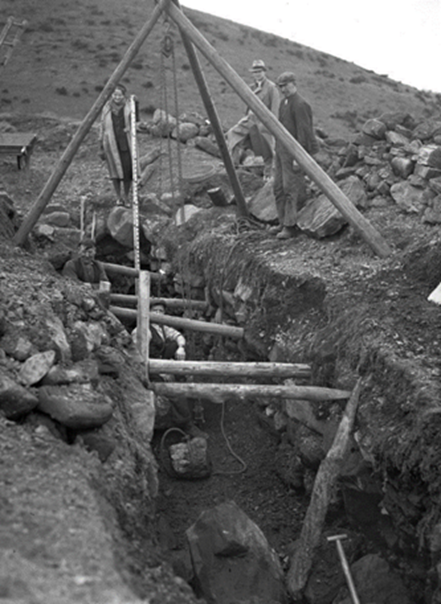
Table 1.1 – Excavations Margaret Participated in with the ELP[38]
| Date | Site | Location |
| 1929 | Chambered cairn | Kindrochat, Perthshire |
| 1931 | Iron Age forts | Earn’s Heugh, Scottish Borders |
| 1932 | Castlelaw fort | Penicuik, Midlothian |
| 1933 | Stone circle | Old Keig, Aberdeenshire |
Nevertheless, this image indicates gendered stereotypes, which assigned ‘archaeological housework’ to women, while men dug.[39] Notably, Margaret’s female contemporaries, Miss Arbuckle, Henderson, and Kennedy, were only identified as ELP representatives, which deemphasised their skills and centred the excavation narrative on Childe.[40] These women’s work in preparing and recording sites must be recognised to avoid reinstating contemporary gendered attitudes. Although recollected as a ‘vehicle’ for Childe’s views, the ELP provided Margaret essential field training to become a credible prehistorian.[41] Nonetheless, Margaret’s student status and gender dictated her capacity for work, as her male mentor directed the excavation.
Overall, Margaret’s desire to pursue archaeology was facilitated by economic and personal support from her family, particularly her father. Consequently, Margaret studied archaeology at university and joined the ELP, which provided foundational knowledge and experience in excavation techniques. Importantly, Margaret’s thesis defined her archaeological expertise and reputability in the field. These factors enabled Margaret to forge an independent professional career.
Secondary literature has considered marriage a watershed moment for female archaeologists. Breeze, Marshall, and Ralston testified marriage marked the end of Margaret Simpson’s career.[42] On the other hand, Pope and Davies argued marriage afforded Peggy Piggott greater access to archaeology outside systems of dependent patronage.[43] In the same way, Margaret’s marriage to John Stewart in 1936 opened opportunities for an alternative career path to academic employment.[44]
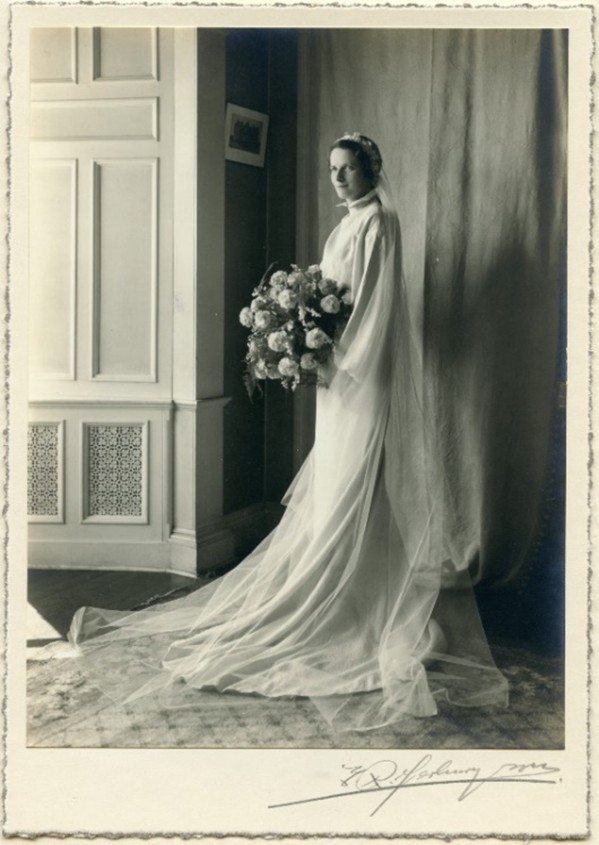
Figure 2.1:
Margaret on her Wedding Day
Source:
Perth Museum and Art Gallery
Marriage determined Margaret’s geographical focus to Perthshire, which broadened her specialism from beaker pottery to prehistoric ritual sites. There is a more complex picture to uncover of how women constructed successful archaeological careers. Margaret took advantage of the opportunities in local heritage societies, which allowed her to lead excavations and become a local specialist outside city institutions. This chapter argues three factors defined Margaret’s career: collaboration with female archaeologists, her role as excavation director, and success in gaining funding.
Excavation: Women’s Work
Margaret worked in a network of female archaeologists and collaborated with four women in professional publications. Margaret’s 1938 excavation of Monzie stone circle with Alison Young is a representative example.
Figure 2.2:
Plan of Monzie Stone Circle (1939)
Source:
MECS and Young, ‘Monzie’. p.63.

Structural records, including figure 2.2, illustrate Margaret and Alison’s ability to lead systematic excavations and produce detailed reports for national publication. In the acknowledgements, Miss Stirling and Dimsdale were thanked for their assistance.[45] Browman explored the idea that female bonding in the field impacted the intellectual development of individual women.[46] However, professional relationships are difficult to extract from excavation reports. The nature of Miss Stirling and Dimsdale’s support was not outlined, and Alison was only mentioned in the title.[47] Consequently, the archive exhibits a hierarchy, which prioritises the most publicised female archaeologists. Nevertheless, Margaret’s commitment to involving women indicates a conscious community of female archaeological practise, which can help recover more women from the archaeological archive.
Margaret: Director of Excavation
Cool Root recognised two concurrent challenges for women in excavation: lack of prior training compared to male peers and chauvinistic male workers, who struggled to accept a female manager.[48] With sufficient experience from university, Margaret affiliated with archaeological societies to become a respected excavation leader, as documented with her thirty projects.[49] The 1963 excavation of Lundin Farm, with amateur archaeologists from Breadalbane Heritage Society (BHS), is a characteristic example. Margaret believed in grass-root observation and described in a letter to John Gilchrist how she divided the site into sections to offer everyone ‘novelty of experience in digging’.[50]

Figure 2.3:
BHS Members Excavating Lundin farm (1963)
Source: BHSA
As figure 2.3 demonstrates women were actively involved and learnt excavation techniques, which contrasts figure 1.2 of Margaret holding the measuring stick. Described as an ‘archaeologist (and housewife)’, Margaret informed the Weekly Scotsman that most diggers were enthusiastic women.[51] Therefore, BHS facilitated female involvement and helped Margaret navigate gendered stereotypes of women’s unsuitability for rigorous outdoor labour. Affiliation with BHS also legitimised Margaret’s research as worthy of national attention, as the excavation welcomed numerous ‘distinguished visitors’, even Childe’s successor Stuart Piggott.[52] In sum, Margaret trained volunteers, who supplied a vital source of skilled labour. In return, Margaret provided stimulating projects and legitimacy through the involvement of a qualified archaeologist. Therefore, Margaret created mutually beneficial relationships with local societies to fuel her excavations.
Funding
Described as a ‘rich man’s profession’, Reyman determined wealth was a secondary limiting factor to gender for women in archaeology.[53] Margaret overcame this barrier by applying to public bodies to finance labour and equipment. Table 2.1 displays the total expenditure for Lundin Farm was £83, worth roughly £1,450.87 today.[54]
Table 2.1 – Expenditure for 1963 Excavation of Lundin Farm.
| Expenditure | Cost |
| Hired Labour | £28 |
| Director’s Fee | £25 |
| Equipment | £17 |
| Architect’s Fee | £5 |
| Photography | £5 |
| Miscellaneous | £3 |
| Total | £83 |
Source: BHSA, ‘BHS Excavation at Lundin Farm, Aberfeldy, May-September 1963’, 20 September 1963, p.2.
Bucolo emphasised the financial tensions female archaeologists faced and security wealth provided.[55] Margaret’s research was supported by her director’s fee, worth thirty-percent of the expenditure. The committee deemed Margaret’s initial pay of £17-14-1 ‘insulting’.[56] Therefore, Margaret drew upon her alumni links to secure £20 from the archaeology department at Edinburgh University, on top of the Carnegie Trust UK’s £50 grant.[57] Promotion and publicity was central to Margaret’s career as she had to present herself as an established professional and successfully liaison with respective bodies to secure funding.
Common obstacles female archaeologists faced can be drawn from Margaret’s career, including gendered expectations, submissive socialisation in the field, and funding. Margaret found support in a wider cohort of female archaeologists and utilised her connection with local societies to establish her professional presence. Margaret’s career trajectory must be briefly compared with her contemporaries to understand how typical it was as a woman. Margaret Simpson went straight into professional employment after graduating from Edinburgh University in 1930.[58] Without university qualifications, Marion Campbell conducted local research in Argyll, which she published with recreational antiquarian societies.[59] Peggy Piggott trained in voluntary excavations, where she identified with likeminded female prehistorians.[60] From these women it can be concluded female archaeologists established various alternative career routes to university institutions, which Pope observed perpetuated male gendering of senior roles.[61] Indeed, Margaret’s male contemporaries, Mortimer Wheeler and Stuart Piggott, both chaired archaeology departments. Alternatively, Margaret engaged with archaeological societies and public archaeology, which deserves further attention.
Chapter 3 – Public Archaeology and Societies
Champion argued work in education and public interface has been regarded unimportant to archaeology’s development, which has obscured women in history writing.[62] Building upon Champion, Meheux used Kathleen Kenyon’s administrative career to challenge such gendered discourses of ‘true’ archaeology as male-cultured excavation.[63] Margaret’s career likewise included administration, education, and community outreach with numerous organisations. Margaret’s diverse involvement demonstrates archaeology operated beyond the realm of excavation and such work deserves historical attention. Due to Margaret’s extensive undertakings, specific examples will be drawn from selected societies to represent a typical aspect of her activity across the organisations, from volunteer participation to heritage management.[64] This chapter aims to challenge public perceptions of archaeology as exclusively digging and demonstrate Margaret’s public and administrative work was crucial to her career.
Hudson claimed the amateur-professional relationship benefited a spectrum of archaeological pursuits.[65] Margaret’s career exemplifies the advantages of volunteer participation to create a positive atmosphere for effective research, which is evident in her survey of Perth with the Perthshire Society of Natural Science (PSNS). Margaret fronted the establishment of PSNS’s Archaeological Section in 1948 and drafted the constitution with Ann Strachan.[66] The section formed the Perth Archaeological Survey Team to evaluate the town’s archaeological potential amidst redevelopment threats.[67] Margaret and Lisbeth Thoms led members, locals, and architects to discover sites, which Margaret plotted on ordinance survey maps.[68] As the first organised fieldwork conducted in Perth, the survey cemented the town’s historical significance. Margaret lectured on ‘The Importance of the Amateur Archaeologist’ and accentuated their new image as excavators with technical skills ‘needed in the service of archaeology’.[69] Indeed, volunteer participation was fundamental to Margaret’s projects and helped her strike roots in the local archaeological community.
Collaboration between professional and amateur archaeologists was integral to Margaret’s work, particularly with the Scottish Regional Group for British Archaeology (SRGBA). Margaret supported the SRGBA’s goal to create a unified voice for Scottish archaeology.[70] As president (1957-1959), Margaret advocated for ‘the expert and the amateur [to] come together on equal terms’, and helped legitimise recreational societies through membership.[71] Subsequently, as editor (1960-1978), Margaret maintained Discovery and Excavation Scotland (DES) as a reputable journal and nationally promoted research from academics and volunteers, including her work with Strathearn Archaeological Society.[72] In sum, Margaret advocated the importance of recreational societies to Scottish archaeology, which helped publish her research across the country. Additionally, Margaret helped integrate local archaeology into national frameworks and reduce division between professional and independent archaeologists.
Margaret endorsed public engagement and education, evident with Breadalbane Heritage Society (BHS). Encouraged by Margaret, Sonia Yellowlees established BHS in 1962, and embarked on a cup-marked stone survey while raising three children.[73] Despite the fact there is no record Margaret had children, she recognised the pressures of parenting and suggested Sonia receive help from academy pupils, which had proven success.[74] For instance, Margaret thanked Miss Fothergill for her students’ ‘cheerful, willing, and enthusiastic way’ during the Ship Inn Close project.[75] Egyptologist Margaret Murray understood education as knowledge production and consumption in any setting.[76] In the same way, Margaret taught on site, as in figure 3.1, and delivered approachable lectures framed as ‘a “chat”: you talk to me as well as I to you’.[77] As a prominent figure in local archaeological circles, Margaret consolidated archaeology within the community, fostered public participation, and made archaeological knowledge accessible for all ages.
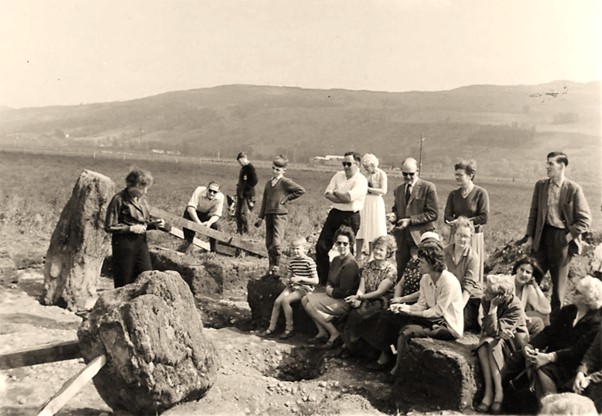
Figure 3.1:
Margaret (left) showing the public the Carse Farm Excavation (1964).
Source: BHSA
Margaret had dual vision for the past and future and was dedicated to preserving Perthshire’s history for future generations. For example, in 1967 Margaret helped found the Perth Civic Trust (PCT) for anyone concerned with Perth’s heritage and development.[78] Margaret hosted the initial meeting in her home, which combined her career and domestic duties, and engaged local newspapers to raise awareness. Margaret fostered collaboration between the PCT and the Scottish Urban Archaeology Trust Limited to compile an inventory of vulnerable buildings and conduct rescue excavations, including a toll-house threatened by road widening.[79] Margaret observed a ‘new outlook’ of growing public consciousness to protect Perthshire’s architectural and archaeological heritage, which is testified in the historic sites stood today.[80] This work in heritage management helped Margaret become a public personality in local archaeology.
Far from being domestic repetitive chores, Margaret’s various roles within societies demonstrates archaeology’s versatility as a discipline. Margaret’s administrative work kept the societies running effectively and legitimised female decision-making. By employing a fruitful blend of volunteers, Margaret encouraged community engagement, disseminated her knowledge through accessible education, and created supportive networks between amateur and professional archaeologists. Crucially, Margaret helped document and preserve Perthshire’s past and solidify its importance in national research. Margaret’s personal influence cannot be missed, as her legacy endures in these societies that flourish today. Rosemary Thomson deemed her one of Perth’s ‘most illustrious citizens’ for her humour, charm, and hospitality.[81]
Although it is conventional to end with Margaret’s death on June 4, 1986, it is more keeping with her spirit to conclude with her legacy to Scottish archaeology. Carr observed archaeologists are remembered for their methodological or locational contribution.[82] Margaret naturally falls into the latter and her legacy can be understood in three sections: Perthshire archaeology, education, and public work. Firstly, Margaret was a leading authority in Perthshire archaeology, and her excavations and surveys helped to establish the county a credible source of archaeological research in Scotland. Secondly, Margaret expanded professional and public knowledge of archaeology through her publications and lectures, which placed Perthshire’s prehistory within national context. Finally, Margaret proved the benefits of public archaeology by engaging the community and forming a competent pool of volunteer archaeologists to assist her research. Margaret was celebrated for her services to all three sectors and was awarded the first female Honorary Fellow of SoASct.[83]
Margaret’s individual contributions were not made in isolation. This paper has made a point of drawing attention to the broader culture of female participation in Scottish archaeology. In doing so, this paper has engaged with the challenges female archaeologists faced, including gendered discourses, economic limitations, and presiding male scholars. Margaret exemplifies how one woman overcame these barriers by defining a specialism, becoming a local expert, collaborating with women, and affiliating with community organisations. Therefore, this paper has contributed to the disciplinary history of Scottish archaeology by highlighting how its professionalisation shaped female career trajectories and broadening appreciation for the title ‘archaeologist’.
This research cannot be viewed as a definitive study of Margaret’s life and career. Givens recommended oral history to complement archival material and improve the scope of biographical data.[84] Interviews with Margaret’s friends, family, and colleagues would help hone in on Margaret’s personal life and how contemporaries understood her contribution to Scottish archaeology. These interviews would provide opportunity to discover unrecorded events, consider social attitudes of the time, and make Margaret’s archaeological activities live again.
Appendix A: Margaret E C Stewart’s Publications List[85]
1930 ‘The Nether Largie Chambered Cairn, Kilmartin, Argyll’, PSAS 64, pp.233-243
1933 (with Howard Kilbride-Jones) ‘Primitive Agriculture in Scotland: with Particular Reference to Unrecorded Celtic Lynchets at Torwoodlee, Galashiels, Selkirkshire’, PSAS 67, pp.70-81
1933 ‘The Prehistoric Antiquities of Benderloch and Appin’, PSAS 67, pp.320-326
1934 ‘A New Analysis of the Early Bronze Age Beaker Pottery of Scotland’, PSAS 68, pp.132-189
1935 (with Stewart Crichton Mitchell) ‘The Metallurgical Analysis of Three Bronze Age Axes’, PSAS 69, pp.424-430
1939 (with Alison Young) ‘Report on Excavation at Monzie’, PSAS 73, pp.62-70
1949 ‘Some Recent Developments in Scottish Prehistory’, Transactions of the Perthshire Society of Natural Science (TPSNS) 10, Part 2, pp.35-38
1953 (with Richard Feachem) ‘Notes: (10) Short Cist, Auchinteek, Perthshire’, PSAS 85, pp.179-180
1956 (with Audrey Henshall) ‘Excavations at Clach na Tiompan, Wester Glen Almond, Perthshire’, PSAS 88, pp.112-124
1956 ‘Kinloch Rannoch’, DES 10, pp.19-20
1961 ‘Strath Tay in the Second Millenium BC: A Field Survey’, PSAS 92, pp.71-84
1961 (with Kathleen Feachem) ‘Kinloch Rannoch’, DES 15, pp.42
1964 ‘The Excavation of Two Circular Enclosures at Dalnaglar, Perthshire’, PSAS 95, pp.134-158
1964 ‘Carse Farm’, DES 18, pp.39-40
1964 ‘Binn Farm, Kinoull’, DES 18, pp.43-44
1966 ‘Excavation of a Circle of Standing Stones at Sandy Road, Scone’, TPSNS 11, pp.7-23
1967 ‘Excavation of a Setting of Standing Stones at Lundin Farm, Near Aberfeldy, Perthshire’, PSAS 98, pp.126-149
1967 ‘Dull: Corn Drying Kiln’, DES 21, pp.37-38
1969 ‘The Ring Forts of Central Perthshire’, TPSNS 12, pp.21-32
1970 ‘Muirhall Farm: Short Cist’, DES 24, p.36
1971 ‘Balnaguard’, DES 25, pp.34-35
1972 ‘Barton Hill Kinnaird: Motte’, DES 26, pp.56-57
1973 ‘The Prehistory of Perthshire of the 4th, 3rd, and 2nd Millennia B.C.’, TPSNS 13, pp.5-13
1975 (with Chris Tabraham) ‘Excavations at Barton Hill, Kinnaird, Perthshire’, Scottish Archaeological Forum 6, pp.58-65
1975 Highland Clachan (Aberdeen: The Forestry Commission)
1976 (with Lisbeth Thoms) It Will Soon Be Too Late: An Archaeological Survey of Perth (Perth: Munro and Scott)
1987 (the late MECS) ‘The Excavation of a Henge, Stone Circles and Metal-Working Area at Moncrieffe, Perthshire’, PSAS 115, pp.125-150
1997 (the late MECS with Gordon Barclay) ‘Excavations in Burial and Ceremonial Sites of the Bronze Age in Tayside’, Tayside and Fife Archaeological Journal (TFAJ) 3, pp.22-54
1999 (the late MECS with John Atkinson, Gordon Barclay, and Adrian Cox) ‘Excavations at Allt na Moine Buidhe and Allt Lochan nan Losgunn, Perthshire’, TFAJ 5, pp.106-138
Appendix B: Table of Projects Directed or Co-Directed by Margaret E C Stewart
| Director | Date | Site | Location | Type of Research | Publication |
| MECS and Alison Young | 1938 | Stone circle | Monzie, Perthshire | Excavation | PSAS 73 (1939), pp.62-70 |
| MECS | 1949 | Cairn and short cist | Glen Cochill, Perthshire | Excavation | DES 3 (1949), p.10 |
| MECS | 1950 | Fort | Castle Law, Perthshire | Excavation | Unpublished – PSNS Archives |
| MECS and Richard Feachem | 1951 | Short cist | Auchinteek, Perthshire | Excavation | PSAS 85 (1953), pp.179-180 |
| Audrey Henshall and MECS | 1954 | Chambered cairns | Wester Glen Almond, Perthshire | Excavation | PSAS 88 (1956) pp.112-124 |
| MECS | 1956 | Circular pits | Kinloch Rannoch, Perthshire | Survey | DES 10 (1956), pp.19-20 |
| MECS | 1958 | Cairns, cists, and stones | Strath Tay, Perthshire | Field Survey | PSAS 92 (1961), pp.71-84 |
| MECS | 1958-1960 | Two circular enclosures | Dalnaglar, Perthshire | Excavation | PSAS 95 (1964), pp.134-158 |
| MECS | 1961 | Standing stone circle | Scone, Perthshire | Excavation | TPSNS 11 (1966), pp.7-23 |
| MECS and Kathleen Feachem | 1961 | Long house two cairn structures | Kinloch Rannoch, Perthshire | Excavation | DES 15 (1961), p.42 |
| MECS | 1962 | Cist | Torr Hill, Perthshire | Excavation | Unpublished – BHSA |
| MECS | 1963 | Standing stones | Lundin Farm, Perthshire | Excavation | PSAS 98 (1967), pp.126-149 |
| MECS | 1964 | Circular enclosure | Binn Farm, Perthshire | Excavation | DES 18 (1964), pp.43-44 |
| MECS | 1964 | Standing stones | Carse Farm, Perthshire | Excavation | DES 18 (1964), pp.39-40 |
| MECS | 1966 | Cist burial | Farleyer, Perthshire | Excavation | TFAJ 3 (1997), pp.42-43 |
| MECS | 1966-1967 | Corn drying kiln | Dull, Perthshire | Excavation | DES 21 (1967), pp.37-38 |
| MECS | 1967 | Ring forts | Central Perthshire | Survey | TPSNS 12, pp.21-32 |
| MECS | 1969 | Cistercian nunnery | Rhynd, Perthshire | Excavation | DES 23 (1969), p.39 |
| MECS | 1969-1970 | Kiln and houses | Allt na Moine Buidhe, Perthshire | Excavation | TFAJ 5 (1999), pp.106-127 |
| MECS | 1970 | Short cist | Muirhall Farm, Perthshire | Excavation | DES 24 (1970), p.36 |
| MECS | 1970 | Three cist burials | Westhaugh of Tulliemet, Perthshire | Excavation | TFAJ 3 (1997), pp.34-41 |
| MECS | 1971 | Standing stone monument | Balnaguard, Perthshire | Excavation | DES 25 (1971), pp.34-35 |
| MECS and Chris Tabraham | 1972 | Motte | Barton Hill, Perthshire | Excavation | DES 26 (1972), pp.56-57 |
| MECS | 1972-1973 | Cairn | Conachan Farm, Perthshire | Excavation | DES 27 (1973), pp.39-40 |
| MECS | 1972, 1974 | Clachan made of three houses | Strathtay, Perthshire | Excavation | Aberdeen: The Forestry, 1975 |
| MECS | 1973 | Short cist cemetery | Almondbank, Perthshire | Excavation | TFAJ 3 (1997), pp.24-33 |
| MECS | 1973 | Cairn | Connachan Farm, Perthshire | Excavation | TFAJ 3 (1997), p.47 |
| MECS | 1974 | Fourposter setting | Tirnie Farm, Perthshire | Excavation | DES 28 (1974), pp.49 |
| MECS | 1974 | Henge and stone circle | Moncrieffe, Perthshire | Excavation | PSAS 115 (1987), pp.125-150 |
| MECS and Lisbeth Thoms | 1975 | Perth high street | Perth, Perthshire | Survey | Perth: Munro and Scott Ltd, 1975 |
Appendix C: Margaret’s Roles in Archaeological Organisations
| Organisation | Role | Date |
| SoASct | Fellow | 1929-1986 |
| Honorary Fellow | 1985-1986 | |
| ELP | Vice-President | 1931-1938, 1946-1948 |
| Member of Editorial Committee | 1932-1935 | |
| PSNS | Chairman of Archaeological Section | 1948-1962 |
| Member of Council | 1947-1949, 1951-1952 | |
| Vice-President | 1949-1950, 1952-1953 | |
| Member of Editorial Sub-Committee | 1964-1966 | |
| SRGBA | Vice-President | 1954-1956 |
| President | 1957-1959 | |
| Editor | 1960-1961 | |
| Honorary Editor | 1962-1972 | |
| Honorary Advisory Editor | 1973-1978 | |
| BHS | Honorary President | 1962-1967 |
| Director of Excavation | 1963-1967 | |
| PCT | Vice-Chairman | 1967-1969 |
| Chairman of Street Survey Sub-Committee | 1968 | |
| Chairman | 1970-1972 |
Appendix D: Women in Scottish Archaeology Mentioned Throughout this Paper
Number(s) correspond to the footnote which mentions each woman.
30. Audrey Henshall
Born in 1927, Audrey Henshall graduated in archaeology from Edinburgh University in 1949. Audrey was appointed a research fellow under Stuart Piggott, which resulted in a pioneering two-part study, The Chambered Tombs of Scotland.[86] Audrey frequently visited the Archaeological Section of PSNS and lectured on various topics, from ‘Celtic Jewellery’ to ‘Early Church Relics’.[87] From 1952, Audrey was assistant curator at the National Museum of Antiquities of Scotland, which stimulated her interest in textiles. Audrey was elected Honorary Fellow of SoASct in 1987, having been assistant secretary since 1970.[88]
40. Miss A. Arbuckle
Minimal information is available on Miss Arbuckle. Nonetheless, she was an active member of the ELP and assisted on excavations at Earn’s Heugh (1931) and Castlelaw Fort (1932).
40. Miss I. R. Henderson
Miss Henderson participated in three excavations under the ELP: Kindrochat (1929), Earn’s Heugh (1931), and Castlelaw Fort (1932). Although Henderson was honorary treasurer of the ELP (1930-1931) and a Fellow of SoASct, information on her subsequent archaeological activities is limited.[89]
40. Miss P. Kennedy
Miss Kennedy was treasurer of the ELP from 1931-1935 and a Fellow of SoASct.[90] Kennedy participated in all four ELP excavations with Margaret. In the 1929 excavation at Kindrochat, Kennedy planned and described the removal of a large tree stump by the eastern cist with Margaret.[91]
42, 58. Margaret Simpson
Born in 1906, Margaret Simpson studied archaeology at Edinburgh University under Gordon Childe, who she assisted in the excavation of Skara Brae (1927-1930). As an active member of the ELP, Margaret was their first secretary in 1929.[92] In 1930, Margaret was elected a Fellow of SoASct and became assistant inspector of ancient monuments, which marked her the ‘first female professional archaeologist in Scotland’.[93] Upon marriage in 1941, Margaret disappeared from archaeological record.
43, 60. Peggy Piggott
Born in 1912, Peggy Cecily Margaret Preston started training in the archaeological field aged eighteen under Mortimer and Tessa Wheeler and joined the Royal Archaeological Institute in 1932.[94] In 1936, Peggy married fellow archaeologist Stuart Piggott. Peggy led and participated in numerous excavations across Scotland, including Hownam Ring hillfort (1948), Bonchester Hill fort (1950), and Milton Loch Crannog (1955).
47. Alison Young
Despite being a Fellow of SoASct and the Society of Antiquaries of London, relatively little information is available on Alison Young. Nevertheless, Alison authored or co-authored seven articles in PSAS, ranging from cup and ring-markings to broches on Scotland’s northern isles. Alison took a keen interest in Perthshire archaeology. She excavated Monzie stone circle in 1938 and visited PSNS excavations, including hut circles in Arnbathie in 1950.[95]
47. Miss Stirling
Having examined PSAS preliminaries around the time Miss Stirling was active in the Monzie excavation, there is no information on her full name, and she does not appear to have been a Fellow of SoASct.
47. Miss Dimsdale
Similar to Miss Stirling, despite being involved in the Monzie excavation, there was virtually no material found on Miss Dimsdale in PSAS, and she does not appear to have been a Fellow of SoASct.
59. Marion Campbell
Born in 1919, Marion Campbell of Kilberry was fascinated with the local history of Argyll. Marion completed an entire field survey of Mid Argyll with her friend Mary Sandeman, which listed all of the known archaeological sites in the area.[96] In 1955, Marion founded the Natural History and Antiquarian Society of Mid Argyll and made 43 contributions to their journal, The Kist.[97] Marion also helped establish the Auchindrain Folk Museum in the early 1960’s and donated her personal collections of artefacts to form the founding collection of Kilmartin Museum.[98]
63. Kathleen Kenyon
Born in 1906, Dame Kathleen Kenyon was best known for developing a grid system for excavation with Mortimer and Tessa Wheeler, which was called the Wheeler-Kenyon method.[99] After the second world war, Kenyon became director of the British School of Archaeology and excavated at Jerusalem and Jericho in the 1950’s, from which material is held at The Hunterian, Glasgow. Kathleen also held various administrative jobs, including secretary then acting director of the University of London Institute of Archaeology, where she taught future archaeologists.[100]
66. Ann D. Strachan
Ann Strachan was secretary and treasurer (1948-1949) of PSNS’s Archaeological and Historical Section. In February 1948, Ann was present at the Section’s first meeting and joined a sub-committee to draft the constitution. Upon resignation as secretary-treasurer on 18 May 1949, a tribute was paid to Ann’s crucial administrative work during the Section’s early days.[101] Ann returned as treasurer from 1957 to 1960.[102]
68. Lisbeth Thoms
After completing a post-graduate diploma in archaeology at Durham University, Lisbeth Thoms joined the staff of Dundee City Council’s Museums in 1972. As assistant keeper, Lisbeth was responsible for field archaeology and urban rescue excavations. In 1974, Lisbeth joined the Perth Archaeological Survey Team, which drew attention to the town’s archaeological potential.[103] Assisted by Margaret, Lisbeth directed the trial excavation of St Ann’s Lane in Perth, and advocated for a complete archaeological survey.[104] Lisbeth was a founding member of the Tayside and Fife Archaeological Committee and president of SoASct from 2002 to 2005.[105]
73. Sonia Yellowlees
After gaining a French language diploma from Geneva University, Sonia married Walter Yellowlees in 1950 and moved to Aberfeldy, Perthshire. Sonia founded BHS in 1962, established its constitution, and remained chairman from 1962 to 1982. With BHS, Sonia conducted a survey of cup and ring-marked stones across Scotland. Walter, Sonia’s husband, marvelled at how she managed the project, household, and three children.[106] Sonia’s dedication and enthusiasm was rewarded when she became honorary patron of BHS in 2003.[107]
75. Rhoda Fothergill
Born in 1929, Rhoda Fothergill graduated from the University of St Andrews and then taught at Kinnoull Primary School from 1953 to 1976.[108] Rhoda became a respected local educator, historian, and archaeologist, who often led guided walks around Perth. As an active member of the PCT, Rhoda engaged school pupils in their projects, which included making improvements to Ship Inn Close and Fountain Close in the 1970’s.[109] Rhoda was honorary secretary of PSNS for 47 years (1968-2015) and was rewarded with honorary life presidency in 2015.[110]
76. Margaret Alice Murray
Born in Calcutta, India, in 1863, Margaret Alice Murray was the first professional female Egyptologist in Britain.[111] In Scotland, Margaret catalogued the Egyptian antiquities at the National Museum, Edinburgh.[112] After studying at University College London under Sir Flinders Petrie, Margaret returned as a lecturer and teacher from 1898 to 1935. Margaret later became interested in witchcraft literature and published an article analysing two witchcraft trials in Edinburgh and Torryburn.[113]
81. Rosemary Thomson
Rosemary Thomson was an active member of the PCT and chairman from 1986 to 1987.[114] As planning convener, Rosemary represented the PCT at public inquiries and worked alongside planning departments to protect areas of great landscape value.[115] Rosemary was considered a local civic champion and worked to stop the local council’s controversial plans to build a new swimming pool on South Inch Park, Perth, which remains to be enjoyed today.
Edinburgh University Archives, ‘Margaret Enid Crichton Mitchell: On First Matriculation: University of Edinburgh 1925-1926’, 1925
Edinburgh University Archives, ‘University of Edinburgh Degree of Master of Arts: Margaret Enid Crichton Mitchell’, 3 July 1930
Edinburgh University Archives, Margaret Crichton Mitchell, ‘The Distribution of Early Bronze Age Types in Scotland’ (unpublished PhD thesis, University of Edinburgh, 1933), 11 April 1933
Edinburgh University Archives, ‘Register of Candidates for the Degree of Doctor of Philosophy (PhD): Margaret Enid Crichton Mitchell’, 30 June 1933
National Records of Scotland, ‘Statutory Registers, Marriages 685/1/159: 1892 Mitchell’, 2 May 1892
National Records of Scotland, ‘Statutory Registers, Marriages 685/9/232: 1936 Stewart’, 30 June 1936
National Records of Scotland, ‘Statutory Registers Deaths 390/495: 1986: Margaret Enid C Stewart’, 4 June 1986
Perth and Kinross Archive, MS214/2/1/1, ‘Perthshire Society of Natural Science: Archaeological Section Minute Book 1948-1965’, 29 February 1948 – 10 February 1965
Perth and Kinross Archive, MS347/5/2/2, ‘Diploma in Education Awarded to Rhoda Agnes Fothergill MA’, 4 July 1952
Perth and Kinross Archive, MS160/1/1, ‘Perth Civic Trust Minute Book 1967-1976’, 6 March 1967 – 5 February 1976
Perth and Kinross Archive, MS119/7/1, Elwena Fraser, ‘Civic Trust Sub-Committee Begin Survey of Perth Streets’, The Perthshire Advertiser, 22 January 1968, p.7
Perth and Kinross Archive, MS347/2/1/3, ‘Margaret E C Stewart’s Letter to Miss Fothergill’, 8 July 1971
Perth and Kinross Archive, MS160/9/13, Margaret E C Stewart, ‘Perth Civic Trust: The First Ten Years: Looking Forward’, 1977
Perth and Kinross Archive, MS214/2/1/2/1/2 (3) HI, ‘Perthshire Society of Natural Science, Archaeological and Historical Section: Constitution’, 1977
Perth and Kinross Archive, MS/60/2/20, ‘Perth Civic Trust Annual Report 1986-1987’, 6 May 1987
Perth and Kinross Archive, MS/60/2/21, ‘Perth Civic Trust Planning Report 1986-1987’, 10 June 1987
Perth and Kinross Archive, MS119/7/1, ‘Perth Civic Trust: 25th Anniversary 1967-1992’, 1992
Perth and Kinross Archive, MS214/2/1/2/1/2 (1) B, ‘Perthshire Society of Natural Science, Archaeological Section: Winter Programme 1961-2000’, 2000
Perth and Kinross Archive, MS214/2/1/2/1/2 (2) G, ‘Perthshire Society of Natural Science, Archaeological Section: List of Members 1948-2005’, 2005
Perth and Kinross Archive, MS347/5/4/3, ‘Life Presidency of Perthshire Society of Natural Science’, 20 March 2015
The Archives of the Breadalbane Heritage Society, ‘Breadalbane Archaeological Society Committee Minutes 1962-1980’, 4 August 1962 – 8 February 1980
The Archives of Breadalbane Heritage Society, ‘Torhill Aberfeldy Science Exercise Book’, 31 August – 4 September 1962
The Archives of the Breadalbane Heritage Society, ‘Breadalbane Archaeological Society Excavation at Lundin Farm, Aberfeldy, May-September 1963’, 20 September 1963
The Archives of Breadalbane Heritage Society, ‘Margaret E C Stewart’s Letter to Mr Gilchrist’, 15 October 1963
The Archives of the Breadalbane Heritage Society, ‘Archaeology? They ‘Dig’ It’, Weekly Scotsman, 14 May 1964
The Archives of the Breadalbane Heritage Society, ‘Excavation at Carse Farm Weem (1964)’, 25 June 1964
The Archives of the Breadalbane Heritage Society, ‘Margaret E C Stewart’s Letter to Sonia Yellowlees with List of Cup-Marked Stone Sites’, 1966
The Archives of the Breadalbane Heritage Society, ‘Summer School of Archaeology: Falkirk 1972’, July 1972
The Archives of the Breadalbane Heritage Society, ‘Margaret E C Stewart Lecture: Introduction to Bronze Age Monuments, Scotland’, September 1972
The Archives of Breadalbane Heritage Society, Fifty Years of Heritage in Breadalbane, 2012
The Archives of the Perthshire Society of Natural Science, ‘Perthshire Society of Natural Science Archaeologists’ 21st Anniversary Party’, The Perthshire Advertiser, 25 October 1969
‘Anniversary Meeting, 2 December 1929’, Proceedings of the Society of Antiquaries of Scotland 64 (1930), pp.1-24
‘Anniversary Meeting, 30 November 1984’, Proceedings of the Society of Antiquaries of Scotland 114 (1985), pp.612-618
Campbell, Marion and Sandeman, Mary, ‘Mid Argyll: A Field Survey of the Historic and Prehistoric Monuments’, Proceedings of the Society of Antiquaries of Scotland 95 (1964), pp.1-125
Childe, Gordon, ‘Excavations at Castelaw Fort, Midlothian’, Proceedings of the Society of Antiquaries of Scotland 67 (1933), pp.362-388
Childe, Gordon, ‘Trial Excavations at the Old Keig Stone Circle, Aberdeenshire’, Proceedings of the Society of Antiquaries of Scotland 67 (1933), pp.37-53
Childe, Gordon, and Forde, Daryll, ‘Excavations in Two Iron Age Forts at Earn’s Heugh, Near Coldingham’, Proceedings of the Society of Antiquaries of Scotland 66 (1932), pp.152-183
Crichton Mitchell, Margaret, ‘The Nether Largie Chambered Cairn, Kilmartin, Argyll’, Proceedings of the Society of Antiquaries of Scotland 64 (1930), pp.233-243
Crichton Mitchell, Margaret, ‘The Prehistoric Antiquities of Benderloch and Appin’, Proceedings of the Society of Antiquaries of Scotland 67 (1933), pp.320-326
Crichton Mitchell, Margaret, ‘A New Analysis of the Early Bronze Age Beaker Pottery of Scotland’, Proceedings of the Society of Antiquaries of Scotland 68 (1934), pp.132-189
Crichton Mitchell, Stewart, and Crichton Mitchell, Margaret, ‘The Metallurgical Analysis of Three Bronze Age Axes’, Proceedings of the Society of Antiquaries of Scotland 69 (1935), pp.424-430
Fisher, Ian, ‘Marion Campbell of Kilberry’, Proceedings of the Society of Antiquaries of Scotland 130 (2002), pp.7-9
Henshall, Audrey, and Stewart, Margaret E C, ‘Excavations at Clach na Tiompan, Wester Glen Almond, Perthshire’, Proceedings of the Society of Antiquaries of Scotland 88 (1956), pp.112-124
Kilbride-Jones, Howard, ‘Editorial’, Transactions of the Edinburgh League of Prehistorians 1 (1932), p.iii
Kilbride-Jones, Howard, ‘Postscript: Three Recollections of Childe the Man’, in The Archaeology of V. Gordon Childe: Contemporary Perspectives (London: University College London Press, 1994), pp.135-139
Kilbride-Jones, Howard and Crichton Mitchell, Margaret, ‘Primitive Agriculture in Scotland: with Particular Reference to Unrecorded Celtic Lynchets at Torwoodlee, Galashiels, Selkirkshire’, Proceedings of the Society of Antiquaries of Scotland 67 (1933), pp.70-81
‘Meeting Notes, 11 March 1901’, Proceedings of the Society of Antiquaries of Scotland 35 (1901), pp.149-153
‘Meeting Notes, 13 April 1936’, Proceedings of the Society of Antiquaries of Scotland 70 (1936), pp.356-362
Murray, Margaret, ‘Catalogue of the Egyptian Antiquities in the National Museum of Antiquities, Edinburgh’, Proceedings of the Society of Antiquaries of Scotland 33 (1899), pp.465-531
Murray, Margaret, ‘Two Trials for Witchcraft’, Proceedings of the Society of Antiquaries of Scotland 56 (1922), pp.46-60
‘Officers and Committee: Session 1930-1931’, Proceedings of the Edinburgh League of Prehistorians 1 (1931), p.ii
‘Officers and Committee: Session 1931-1932’, Transactions of the Edinburgh League of Prehistorians 1 (1932), p.ii
‘Preliminaries: Session 1937-1938’, Proceedings of the Society of Antiquaries of Scotland, 72 (1938), pp.i-xlvi
‘Preliminaries: Session 1986-1987’, Proceedings of the Society of Antiquaries of Scotland 117 (1988), pp.i-vi
Scotland’s People <https://www.scotlandspeople.gov.uk/> [accessed 11 November 2023]
Simpson, George, ‘Dr A. Crichton Mitchell’, The Meteorological Magazine 59 (1924), pp.186-187
Stark, Gordon, ‘Foreword’, in Cup-Marked Stones in Strathtay, ed. Gordon Stark (Edinburgh: Scotland Magazine, 2005), p.2
Stevenson, Jack, ‘Audrey Henshall, OBE MA FSA HonFSAScot’, Proceedings of the Society of Antiquaries of Scotland 151 (2022), pp.7-13
Stewart, Margaret E C, ‘Some Recent Developments in Scottish Prehistory’, Transactions of the Perthshire Society of Natural Science 10, Part 2 (1949), pp.35-38
Stewart, Margaret E C, ‘Kinloch Rannoch’, Discovery and Excavation Scotland 10 (1956), pp.19-20
Stewart, Margaret E C, ‘Foreword’, Discovery and Excavation Scotland 11 (1957), p.3
Stewart, Margaret E C, ‘Strath Tay in the Second Millenium BC: A Field Survey’, Proceedings of the Society of Antiquaries of Scotland 92 (1961), pp.71-84
Stewart, Margaret E C, ‘Binn Farm, Kinoull’, Discovery and Excavation Scotland 18 (1964), pp.43-44
Stewart, Margaret E C, ‘Carse Farm’, Discovery and Excavation Scotland 18 (1964), pp.39-40
Stewart, Margaret E C, ‘The Excavation of Two Circular Enclosures at Dalnaglar, Perthshire’, Proceedings of the Society of Antiquaries of Scotland 95 (1964), pp.134-158
Stewart, Margaret E C, ‘Excavation of a Circle of Standing Stones at Sandy Road, Scone, Perthshire’, Transactions of the Perthshire Society of Natural Science 11 (1966), pp.7-23
Stewart, Margaret E C, ‘Excavation of a Setting of Standing Stones at Lundin Farm, Near Aberfeldy, Perthshire’, Proceedings of the Society of Antiquaries of Scotland, 98 (1967), pp.126-149
Stewart, Margaret E C, ‘Dull: Corn Drying Kiln’, Discovery and Excavation Scotland 21 (1967), pp.37-38
Stewart, Margaret E C, ‘The Ring Forts of Central Perthshire’, Transactions of the Perthshire Society of Natural Science 12 (1969), pp.21-32
Stewart, Margaret E C, ‘Muirhall Farm: Short Cist’, Discovery and Excavation Scotland 24 (1970), p.36
Stewart, Margaret E C, ‘Balnaguard’, Discovery and Excavation Scotland 25 (1971), pp.34-35
Stewart, Margaret E C, ‘Barton Hill, Kinnaird: Motte’, Discovery and Excavation Scotland 26 (1972), pp.56-57
Stewart, Margaret E C, ‘Connachan Cairn’, Discovery and Excavation Scotland 26 (1972), pp.34-35
Stewart, Margaret E C, ‘Conachan Farm: Cairn’, Discovery and Excavation Scotland 27 (1973), pp.39-40
Stewart, Margaret E C, ‘The Prehistory of Perthshire of the 4th, 3rd, and 2nd Millenia B.C.’, Transactions of the Perthshire Society of Natural Science 13 (1973), pp.5-13
Stewart, Margaret E C, ‘Tirnie Farm: Fourposter Setting’, Discovery and Excavation Scotland 28 (1974), p.49
Stewart, Margaret E C, Highland Clachan (Aberdeen: The Forestry Commission Aberdeen, 1975)
Stewart, Margaret E C, ‘The Excavation of a Henge, Stone Circles and Metal-Working Area at Moncrieffe, Perthshire’, Proceedings of the Society of Antiquaries of Scotland 115 (1987), pp.125-150
Stewart, Margaret E C, Atkinson, John, Barcley, Gordon, and Cox, Adrian, ‘Excavations at Allt na Moine Buidhe and Allt Lochan nan Losgunn, Perthshire’, Tayside and Fife Archaeological Journal 5 (1999), pp.106-138
Stewart, Margaret E C and Barclay, Gordon, ‘Excavations in Burial and Ceremonial Sites of the Bronze Age in Tayside’, Tayside and Fife Archaeological Journal 3 (1997), pp.22-54
Stewart, Margaret E C and Feachem, Kathleen, ‘Kinloch Rannoch’, Discovery and Excavation Scotland 15 (1961), p.42
Stewart, Margaret E C and Feachem, Richard, ‘Notes: (10) Short Cist, Auchinteek, Perthshire’, Proceedings of the Society of Antiquaries of Scotland 85 (1953), pp.179-180
Stewart, Margaret E C and Tabraham, Chris, ‘Excavations at Barton Hill, Kinnaird, Perthshire’, Scottish Archaeological Forum 6 (1975), pp.58-65
Stewart, Margaret E C and Thoms, Lisbeth, It Will Soon Be Too Late: An Archaeological Survey of Perth (Perth: Munro and Scott, 1976)
Taylor, David, ‘Dr Margaret E C Stewart (An Appreciation)’, The Perthshire Advertiser, 10 June 1986, p.2
Thoms, Lisbeth, ‘Trial Excavation at St Ann’s Lane, Perth’, Proceedings of the Society of Antiquaries of Scotland 112 (1983), pp.437-454
Watson, Robert, ‘Obituary: Dr. Alexander Crichton Mitchell’, The Meteorological Magazine 81 (1952), p.189
Yellowlees, Sonia, ‘Gazetteer’, in Cup-Marked Stones in Strathtay, ed. Gordon Stark (Edinburgh: Scotland Magazine, 2005), pp.7-22
Yellowlees, Walter, ‘Sonia Yellowlees’, in Cup-Marked Stones in Strathtay, ed. Gordon Stark (Edinburgh: Scotland Magazine, 2005), pp.24-27
Young, Alison, and Stewart, Margaret E C, ‘Report on Excavation at Monzie’, Proceedings of the Society of Antiquaries of Scotland 73 (1939), pp.62-70
Anderson, Robert, ‘The Construction of a Modern University’, in The University of Edinburgh eds. Robert Anderson, Michael Lynch, and Nicholas Phillipson (Edinburgh: Edinburgh University Press, 2003), pp.103-207
Arnold, Bettina, ‘Man, the Hunter and Field Archaeologist Vs. Woman, the Gatherer and Laboratory Analyst’, in Gender Stereotypes in Archaeology, eds. Laura Coltofean-Arizancu, Bisserka Gaydarska, and Uroš Matić (Leiden: Sidestone Press, 2021), pp.10-11
Arwill-Nordbladh, Elisabeth, ‘Twelve Timely Tales: On Biographies of Pioneering Women Archaeologists’, Reviews in Anthropology 37 (2008), pp.136-168
Bank of England <https://www.bankofengland.co.uk/> [accessed 08 February 2024]
Beyond Nobility: Re-Evaluating Women’s Work in Archaeology, History and Heritage, 1870-1950 <https://beyond-notability.wikibase.cloud/wiki/Main_Page> [accessed 08 November 2023]
Breaking Ground: Women in Old World Archaeology <https://www.brown.edu/Research/Breaking_Ground/introduction.php> [accessed 12 January 2024]
Breeze, David, Marshall, Rosalind, and Ralston, Ian, ‘Marguerite Wood and Margaret Simpson, Two Pioneering Scottish Women’, Scottish Archaeological Journal 41 (2019), pp.108-118
Browman, David, Cultural Negotiations: The Role of Women in the Founding of Americanist Archaeology (Lincoln: University of Nebraska Press, 2013)
Bucolo, Raffaella, ‘Biographical Notes on Margarete Gütschow(1871-1951) and the Role of Early Twentieth-Century Women Archaeologists’, Bulletin of the History of Archaeology 27 (2017), pp.1-5
Cane, Charlotte, Gilchrist, Roberta, and O’Sullivan, Deirdre, ‘Women in Archaeology in Britain: Three Papers’, Archaeological Papers of the American Anthropological Association 5 (1994), pp.91-97
Canmore: National Record of the Historic Environment <https://canmore.org.uk/> [accessed 13 December 2023]
Carr, Lydia, Tessa Verney Wheeler: Women and Archaeology Before World War Two (Oxford: Oxford University Press, 2012)
Champion, Sara, ‘Women in British Archaeology: Visible and Invisible’, in Excavating Women: A History of Women in European Archaeology, eds. Margarita Diaz-Andreu and Marie Louise Stig Sorensen (London: Routledge, 1998), pp.175-197
Cool Root, Margaret, ‘Introduction: Women of the Field, Defining the Gendered Experience’, in Breaking Ground: Pioneering Women Archaeologists, eds. Getzel Cohen and Martha Sharp Joukowsky (Ann Arbor: University of Michigan Press, 2006), pp.1-33
Dever, William, ‘Kathleen Kenyon (1906-1978)’, in Breaking Ground: Pioneering Women Archaeologists, eds. Getzel Cohen and Martha Sharp Joukowsky (Ann Arbor: University of Michigan Press, 2006), pp.525-553
Diaz-Andreu, Margarita, and Stig Sorensen, Marie Louise, ‘Excavating Women: Towards an Engendered History of Archaeology’, in Excavating Women: A History of Women in European Archaeology, eds. Margarita Diaz-Andreu and Marie Louise Stig Sorensen (London: Routledge, 1998), pp.1-28
Dyhouse, Carol, No Distinction of Sex? Women in British Universities, 1870-1939 (London: University College London Press, 1995)
Elster, Ernestine, ‘Marija Gimbutas: Setting the Agenda’, in Archaeology and Women: Ancient and Modern Issues, eds. Sue Hamilton, Ruth Whitehouse, and Katherine Wright (Walnut Creek: Left Coast Press, 2007), pp.83-120
Evans, Christopher, ‘Archaeology and Modern Times: Bersu’s Woodbury 1938 and 1939’, Antiquity 63 (1989), pp.436-450
Gero, Joan, ‘Excavation Bias and the Woman at Home Ideology’, Archaeological Papers of the American Anthropological Association 5 (1994), pp.37-42
Gilchrist, Roberta, ‘Women’s Archaeology? Political Feminism, Gender Theory, and Historical Revision’, Antiquity 65 (1991), pp.495-501
Givens, Douglas, ‘The Role of Biography in Writing the History of Archaeology’, in Histories of Archaeology: A Reader in the History of Archaeology, eds. Tim Murray and Christopher Evans (Oxford: Oxford University Press, 2008), pp.177-193
Green, Sally, Prehistorian: A Biography of V. Gordon Childe (Wiltshire: Moonraker Press, 1981)
Hamilton, Sheila, ‘Interviewing the Middle Class: Women Graduates of the Scottish Universities c.1910-1935’, Oral History 10 (1982), pp.58-67
Hamilton, Sue, ‘Women in Practise: Women in British Contract Field Archaeology’, in Archaeology and Women: Ancient and Modern Issues, eds. Sue Hamilton, Ruth Whitehouse, and Katherine Wright (Walnut Creek: Left Coast Press, 2007), pp.121-146
Hamilton, Sue, Whitehouse, Ruth, and Wright, Katherine, ‘Introduction’, in Archaeology and Women: Ancient and Modern Issues, eds. Sue Hamilton, Ruth Whitehouse, and Katherine Wright (Walnut Creek: Left Coast Press, 2007), pp.13-24
Hays-Gilpin, Kelley, ‘Feminist Scholarship in Archaeology’, The Annals of the American Academy of Political and Social Science 571 (2000), pp.89-106
Heise, Marc, ‘Heads North or East? A Re-Examination of Beaker Burials in Britain’ (unpublished PhD thesis, University of Edinburgh, 2014)
Hills, Catherine, ‘Women Archaeologists in 20th-Century Britain. Response to Rachel Pope’, Archaeological Dialogues 19 (2012), pp.75-80
Hudson, Kenneth, A Social History of Archaeology: The British Experience (London: Macmillan Press, 1981)
Levine, Mary Ann, ‘Presenting the Past: A Review of Research on Women in Archaeology’, Archaeological Papers of the American Anthropological Association 5 (1994), pp.23-36
Meheux, Katie, ‘An Awfully Nice Job’. Kathleen Kenyon as Secretary and Acting Director of the University of London Institute of Archaeology, 1935-1945’, Archaeology International 21 (2018), pp.122-140
Mina, Maria, ‘Women Have Equal Career Chances in Archaeology as Men’, Gender Stereotypes in Archaeology, eds. Laura Coltofean-Arizancu, Bisserka Gaydarska, and Uroš Matić (Leiden: Sidestone Press, 2021), pp.54-55
Moorey, Peter Roger, ‘British Women in Near Eastern Archaeology: Kathleen Kenyon and the Pioneers’, Palestine Exploration Quarterly 124 (1992), pp.91-100
Pope, Rachel, ‘Processual Archaeology and Gender Politics. The Loss of Innocence’, Archaeological Dialogues 18 (2011), pp.59-86
Pope, Rachel, Women in the Present: Women in the Past (Online keynote: Australian Archaeological Institute, 2021) <https://www.youtube.com/watch?v=hJe6388wmSY> [accessed 05 January 2024]
Pope, Rachel and Davies, Mairi, ‘Peggy Piggott: Women and British Archaeology (1930-1945)’, Oxford Journal of Archaeology 42 (2023), pp.256-279
Ralston, Ian, ‘Gordon Childe and Scottish Archaeology: The Edinburgh Years 1927-1946’, European Journal of Archaeology 12 (2009), pp.47-90
Reyman, Johnathan, ‘Gender and Class in Archaeology: Then and Now’, Archaeological Papers of the American Anthropological Association 5 (1994), pp.83-90
Schofield, John, Carman, John, and Belford, Paul, Archaeological Practise in Great Britain (New York: Springer, 2011)
Scholma-Mason, Nela, ‘Eliza D’Oyly Traill Burroughs (1849-1908): A Voice from the ‘Unrecorded Past’, Proceedings of the Society of Antiquaries of Scotland 150 (2021), pp.279-299
Scott, Joan, ‘Gender: A Useful Category of Analysis’, The American Historical Review 91 (1986), pp.1053-1075
Sheppard, Kathleen, The Life of Margaret Alice Murray: A Women’s Work in Archaeology (Lanham: Lexington Books, 2013)
Society of Antiquaries of Scotland <https://www.socantscot.org/> [accessed 17 November 2023]
Stig Sorensen, Marie Louise, ‘Rescue and Recovery: On Historiographies of Female Archaeologists’, in Excavating Women: A History of Women in European Archaeology, eds. Margarita Diaz-Andreu and Marie Louise Stig Sorensen (London: Routledge, 1998), pp.31-60
Stig Sorensen, Marie Louise, ‘On Gender Negotiation and its Materiality’, in Archaeology and Women: Ancient and Modern Issues, eds. Sue Hamilton, Ruth Whitehouse, and Katherine Wright (Walnut Creek: Left Coast Press, 2007), pp.41-51
The Hunterian <https://www.gla.ac.uk/hunterian/> [accessed 23 December 2023]
The Kist <http://kist.scot/index.html> [accessed 10 November 2023]
Trigger, Bruce, Gordon Childe: Revolutions in Archaeology (London: Thames and Hudson, 1980)
Trowelblazers <https://trowelblazers.com/about/> [accessed 31 October 2023]
[1] MECS will be referred to as Margaret in this paper. Any other Margaret will be referred to with their full name.
[2] Mary AnnLevine, ‘Presenting the Past: A Review of Research on Women in Archaeology’ APAAA 5 (1994), p.24.
[3] Margaret Cool Root, ‘Introduction’, in Breaking Ground: Pioneering Women Archaeologists, eds. Getzel Cohen and Martha Sharp Joukowsky (Ann Arbor: University of Michigan Press, 2006), p.4.
[4] Sue Hamilton, Ruth Whitehouse, and Katherine Wright, ‘Introduction’, in Archaeology and Women: Ancient and Modern Issues, eds. Sue Hamilton, Ruth Whitehouse, and Katherine Wright (Walnut Creek: Left Coast Press, 2007), p.18.
[5] Lydia Carr, Tessa Verney Wheeler: Women and Archaeology Before World War Two (Oxford: Oxford University Press, 2012), pp.12-13.
[6] Roberta Gilchrist, ‘Women’s Archaeology? Political Feminism, Gender Theory, and Historical Revision’, Antiquity 65 (1991), p.498.
[7] Rachel Pope, Women in the Present: Women in the Past (Online Keynote: Australian Archaeological Institute, 2021) <https://www.youtube.com/watch?v=hJe6388wmSY> [accessed 13 December 2023]
[8] Marie Louise Stig Sorensen, ‘Rescue and Recovery: On Historiographies of Female Archaeologists’, in Excavating Women: A History of Women in European Archaeology, eds. Margarita Diaz-Andreu and Marie Louise Stig Sorensen (London: Routledge, 1998), pp.34-36.
[9] Carr, Tessa, p.251.
[10] David Browman, Cultural Negotiations: The Role of Women in the Founding of Americanist Archaeology (Lincoln: University of Nebraska Press, 2013), pp.4-5.
[11] See appendix D for brief biographies of these women.
[12] Sara Champion, ‘Women in British Archaeology: Visible and Invisible’, in Excavating Women: A History of Women in European Archaeology, eds. Margarita Diaz-Andreu and Marie Louise Stig Sorensen (London: Routledge, 1998), p.179.
[13] David Breeze, Rosalind Marshall, and Ian Ralston, ‘Marguerite Wood and Margaret Simpson, Two Pioneering Scottish Women’, Scottish Archaeological Journal 41 (2019), p.113.
[14] Nela Scholma-Mason, ‘Eliza D’Oyly Traill Burroughs (1849-1908): A Voice from the ‘Unrecorded Past’, PSAS 150 (2021), pp.279-280.
[15] See MECS’s publications list in appendix A.
[16] Christopher Evans, ‘Archaeology and Modern Times: Bersu’s Woodbury 1938 and 1939’, Antiquity 63 (1989), p.436.
[17] Stig Sorensen, ‘Rescue’, p.54.
[18]John Schofield, John Carman, and Paul Belford, Archaeological Practise in Great Britain (New York: Springer, 2011), p.33.
[19] Katie Meheux, ‘An Awfully Nice Job’. Kathleen Kenyon as Secretary and Acting Director of the University of London Institute of Archaeology, 1935-1945’, Archaeology International 21 (2018), pp.123-124.
[20] ‘Meeting Notes, 11 March 1901’, PSAS 35 (1901), p.149.
[21] Excluding female contributors.
[22] Douglas Givens, ‘The Role of Biography in Writing the History of Archaeology’, in Histories of Archaeology, eds. Tim Murray and Christopher Evans (Oxford: Oxford University Press, 2008), p.183.
[23] Sheila Hamilton, ‘Interviewing the Middle Class: Women Graduates of the Scottish Universities c.1910-1935’, Oral History 10 (1982), pp.58-60.
[24] EUA, ‘MECS: On First Matriculation: UoE 1925-1926’, 1925.
[25] George Simpson, ‘Dr A. Crichton Mitchell’, The Meteorological Magazine 59 (1924), p.186.
[26] EUA, ‘Matriculation’.
[27] Rosemary Thomson, ‘Dr NECS Dies’, The Perthshire Asdvertiser, 6 June 1986, p.1.
[28] EUA, ‘UoE Degree of Master of Arts: MECS’, 3 July 1930, pp.1-2.
[29] Browman, Negotiations, p.249.
[30] See appendix D.
[31] MECS, ‘A New Analysis of the Early Bronze Age Beaker Pottery of Scotland’, PSAS 68 (1934), p.134.
[32] ‘Meeting Notes, 13 April 1936’, PSAS 70 (1936), pp.356-357.
[33] Marc Heise, ‘Heads North or East? A Re-Examination of Beaker Burials in Britain’ (unpublished PhD thesis, UoE, 2014), pp.47-48.
[34] Ian Ralston, ‘Gordon Childe and Scottish Archaeology: The Edinburgh Years 1927-1946’, European Journal of Archaeology 12 (2009), p.65.
[35] MECS, ‘Analysis’, p.162.
[36] Sue Hamilton, ‘Women in Practise: Women in British Contract Field Archaeology’, in Archaeology and Women: Ancient and Modern Issues, eds. Sue Hamilton, Ruth Whitehouse, and Katherine Wright (Walnut Creek: Left Coast Press, 2007), p.122.
[37] Howard Kilbride-Jones, ‘Editorial’, TELP 1 (1932), p.iii
[38] See ‘Childe’ in bibliography.
[39] Gilchrist, ‘Women’s’, p.496.
[40] See appendix D.
[41] Howard Kilbride-Jones, ‘Postscript: Three Recollections of Childe the Man’, in The Archaeology of V. Gordon Childe: Contemporary Perspectives, ed. David Harris (London: University College London Press, 1994), p.137.
[42] Breeze, Marshall, and Ralston, ‘Marguerite’, p.115. See appendix D.
[43] Rachel Pope and Mairi Davies, ‘Peggy Piggott: Women and British Archaeology (1930-1945)’, Oxford Journal of Archaeology 42 (2023), p.263. See appendix D.
[44] National Records of Scotland, ‘Statutory Registers, Marriages 685/9/232: 1936 Stewart’, 30 June 1936.
[45] Alison Young and MECS, ‘Report on Excavation at Monzie’, PSAS 73 (1939), p.68.
[46] Browman, Negotiations, p.275.
[47] See appendix D.
[48] Cool Root, ‘Introduction’, pp.13-14.
[49] See full table of projects in appendix B.
[50] BHSA, ‘MECS’s Letter to Mr Gilchrist’, 15 October 1963, p.2-3.
[51] BHSA, ‘Archaeology? They ‘Dig’ It’, Weekly Scotsman, 14 May 1964.
[52] BHSA, ‘Gilchrist’, p.1.
[53] Jonathan Reyman, ‘Gender and Class in Archaeology: Then and Now’, APAAA 5 (1994), p.86.
[54] ‘Inflation Calculator’, Bank of England <https://www.bankofengland.co.uk/monetary-policy/inflation/inflation-calculator> [accessed 08 February 2024]
[55] Raffaella Bucolo, ‘Biographical Notes on Margarete Gütschow(1871-1951) and the Role of Early Twentieth-Century Women Archaeologists’, Bulletin of the History of Archaeology 27 (2017), pp.2-3.
[56] BHSA, ‘BHS Committee Minutes 1962-1980’, 7 June 1963.
[57] BHSA, ‘Lundin’, p.2.
[58] Breeze, Marshall, and Ralston, ‘Marguerite’, p.113. See appendix D.
[59] Ian Fisher, ‘Marion Campbell of Kilberry’, PSAS 130 (2002), p.8. See appendix D.
[60] Pope and Davies, ‘Peggy’, p.260. See appendix D.
[61] Rachel Pope, ‘Processual Archaeology and Gender Politics. The Loss of Innocence’, Archaeological Dialogues 18 (2011), p.75.
[62] Champion, ‘Women’, pp.191-192.
[63] Meheux, ‘Kathleen’, p.123. See appendix D.
[64] See table of Margaret’s roles within societies in appendix C.
[65] Kenneth Hudson, A Social History of Archaeology: The British Experience (London: Macmillan Press, 1981), p.154.
[66] PKA, MS214/2/1/1, ‘PSNS: Archaeological Section Minute Book 1948-1965’, 29 February 1948. See appendix D.
[67] MECS and Lisbeth Thoms, It Will Soon Be Too Late: An Archaeological Survey of Perth (Perth: Munro and Scott, 1976), p.3, 5.
[68] See appendix D.
[69] PSNS Archives, ‘PSNS Archaeologists’ 21st Anniversary Party’, The Perthshire Advertiser, 25 October 1969.
[70] David Taylor, ‘MECS’, PSAS 118 (1989), p.2.
[71] MECS, ‘Foreword’, DES 11 (1957), p.3.
[72] MECS, ‘Connachan Cairn’, DES 26 (1972), p.3
[73] BHSA, ‘Fifty Years of Heritage in Breadalbane’, 2012, p.1. See appendix D.
[74] BHSA, ‘MECS’s Letter to Sonia Yellowlees’, 1966.
[75] PKA, MS347/2/1/3, ‘MECS’s Letter to Miss Fothergill’, 8 July 1971. See appendix D.
[76] Kathleen Sheppard, The Life of Margaret Alice Murray (Lanham: Lexington Books, 2013), p.96. See appendix D.
[77] BHSA, ‘MECS Lecture: Introduction to Bronze Age Monuments, Scotland’, September 1972, p.1.
[78] PKA, MS160/1/1, ‘PCT Minute Book 1967-1976’, 6 March 1967.
[79] PKA, MS119/7/1, Elwena Fraser, ‘Civic Trust Sub-Committee Begin Survey of Perth Streets’, The Perthshire Advertiser, 22 January 1968, p.7. xxx
[80] PKA, MS160/9/13, MECS, ‘PCT The First Ten Years: Looking Forward’, 1977, p.4.
[81] Thomson, ‘MECS’, p.2. See appendix D.
[82] Carr, Tessa, pp.245-246.
[83] Taylor, ‘MECS’, p.2.
[84] Givens, ‘Biography’, pp.189-190.
[85] For the purpose of this list, contributions have not been included. Any mistakes or omissions are my own.
[86] Jack Stevenson, ‘Audrey Henshall, OBE MA FSA HonFSAScot’, PSAS 151 (2022), p.7.
[87] PKA, ‘PSNS: Minute Book’, 17 March 1965.
[88] ‘Preliminaries: Session 1986-1987’, PSAS 117 (1988), p.v.
[89] ‘Officers and Committee: Session 1930-1931’, PELP 1 (1931), p.ii.
[90] ‘Officers and Committee: Session 1931-1932’, TELP 1 (1932), p.ii.
[91] Gordon Childe, ‘The Chambered Long Cairn at Kindrochat, Near Comrie, Perthshire’, PSAS 65 (1931), pp.287, 289.
[92] ‘Officers: 1930-1931’, p.ii.
[93] ‘Preliminaries: Session 1937-1938’, PSAS 72 (1938), p.xxxiv.
Breeze, Marshall, and Ralston, ‘Marguerite’, p.113.
[94] Pope and Davies, ‘Peggy’, p.260.
[95] PKA, ‘PSNS: Minute Book’, 24 June 1950.
[96] Marion Campbell and Mary Sandeman, ‘Mid Argyll: A Field Survey of the Historic and Prehistoric Monuments’, PSAS 95 (1964), p.1.
[97] ‘Publications’, The Kist <http://kist.scot/publications.html> [accessed 10 November 2023]
[98] Fisher, ‘Marion’, p.8.
[99] William Dever, ‘Kathleen Kenyon (1906-1978)’, in Breaking Ground: Pioneering Women Archaeologists, eds. Getzel Cohen and Martha Sharp Joukowsky (Ann Arbor: University of Michigan Press, 2006), pp.526-527.
[100] Meheux, ‘Kathleen’, p.131.
[101] PKA, ‘PSNS: Minute Book’, 18 May 1949.
[102] PKA, MS214/2/1/2/1/2 (2) G, ‘PSNS Archaeological Section: List of Members 1948-2005’, 2005, p.74
[103] MECS and Thoms, Too Late, p.3.
[104] Lisbeth Thoms, ‘Trial Excavation at St Ann’s Lane, Perth’, PSAS 112 (1983), p.437.
[105] ‘Presidents’, SoASct <https://www.socantscot.org/about-us/presidents/> [accessed 17 November 2023]
[106] Walter Yellowlees, ‘Sonia Yellowlees’, in Cup-Marked Stones in Strathtay, ed. Gordon Stark (Edinburgh: Scotland Magazine, 2005), pp.24-25, 27.
[107] Gordon Stark, ‘Foreword’, in Cup-Marked Stones in Strathtay, ed. Gordon Stark (Edinburgh: Scotland Magazine, 2005), p.2.
[108] PKA, MS347/5/2/2, ‘Diploma in Education Awarded to Rhoda Agnes Fothergill MA’, 4 July 1952.
[109] PKA, ‘Letter to Fothergill’.
[110] ‘Council 1968-69’, TPSNS 12 (1969), p.1.
PKA, MS347/5/4/3, ‘Life Presidency of PSNS’, 20 March 2015.
[111] Sheppard, Margaret Murray, p.8.
[112] Margaret Murray, ‘Catalogue of the Egyptian Antiquities in the National Museum of Antiquities, Edinburgh’, PSAS 33 (1899), p.465.
[113] Margaret Murray, ‘Two Trials for Witchcraft’, PSAS 56 (1922), p.46.
[114] PKA, MS/60/2/20, ‘PCT Annual Report 1986-1987’, 6 May 1987.
[115] PKA, MS/60/2/21, ‘PCT Planning Report 1986-1987’, 10 June 1987.
Amy Jo Kearton, 2024
 Breadalbane Heritage Society
You must be logged in to post a comment.