
We began to record our winter talks in September 2020, when our live ‘in person’ talks at the Breadalbane Community Campus building were all cancelled because of the Covid lockdown restrictions imposed throughout the UK. At that point, we transferred the presentation of all the 2020-21 winter season of talks to the Zoom online platform which, having gained the speaker’s approval, allowed us easily to record each talk.
As a result of the relaxation of the Covid restrictions, each winter season since 2021 we have been able to revert to presenting four of our talks live in-person at the Campus building whilst continuing with Zoom presentations for the January and February talks.
When we have received approval from the speaker, we have continued to record these talks, and the links to each of these is provided below.
2020-21 Season
Colin presented an eclectic dip into the assortment box of Pitlochry’s local history, by looking at lots of groupings of three things to show how Pitlochry has been shaped over the years. Topics and artefacts included the Lude Harp, Black Spout toggle and the Clach na Brataich. Watch here: Pitlochry in Threes
Lesley looked at the history of many of the churches in the local area of Dull to Strathtay which have been ‘lost’ and those which have survived to discover what has happened to them and why.
Watch here: Where have all the Churches gone?
Helen showed you how to use ‘Ancestry’ and ‘ScotlandsPeople’ to search births, marriages, deaths, censuses and other records, indicating the range of information that is available and what to expect when you start to search. Her talk included some tips and advice, and suggestions for searching newspapers, gravestones and other useful websites. Watch here: Researching your Family History in Scotland.
A fun and informative quiz evening to brighten up January blues, including questions on the natural history, folklore, archaeology, history, and songs relating to the Breadalbane area and beyond, providing opportunities to gain more knowledge of these topics.
Watch here: Breadalbane Quiz.

Jim presented an excellent talk on the Antonine Wall to the Society last year and is now returning to tell us about camps, forts, fortlets and signal stations established and used by the Roman army in Perthshire during the 1st and 2nd centuries A.D. Watch here: The Roman Army in Perthshire.

Tommy Pringle presented a series of photographs and postcards taken over the last 150 years showing changes to buildings in Aberfeldy starting in Kenmore Street and working eastwards along to the Dewar’s Aberfeldy Distillery. Watch here: Aberfeldy Past and Present.
2021-22 Season
David’s talk encompassed the life cycle of the salmon, the drastic reduction in salmon numbers and current scientific research studies, providing an overview of the status of the River Tay’s salmon population and fisheries, comparing the past with what the future might hold. Watch here: ‘Salmon and Salmon Fishing in the River Tay’.
Dr. Liz Auty, John Muir Trust’s East Schiehallion Property Manager, discussed the Reverend Nevil Maskelyne’s 1774 expedition to Schiehallion, the people, the experiment to ‘weigh’ the world and the mountain, along with her work for the John Muir Trust. Watch here: ‘The Attraction of Mountains’.
John gave an overview of the early medieval sculpture of Highland Perthshire, following its distribution from west to east along the glens and straths, highlighting what is rare and unusual. He examined the distribution of the sculpture to see what that tells us about its cultural origins and thus assess just how “Pictish” this part of Perthshire was. Watch here: ‘The early Medieval Sculpture of Highland Perthshire‘.
Dr. Nicki Scott described how although the survival of so many Pictish carvings highlights the long tradition of Christian worship across Angus, the tradition of monumental display continued in the medieval period, most famously at Arbroath Abbey. Watch here: ‘Ancient Magnificence: Arbroath Abbey and Beyond’.
Annette described how, despite the tragic shortness of his life, James Marjoribanks MacLaren (1853-1890) achieved much in his architectural career and is recognised as a pioneer of the Arts & Crafts Movement. She discussed how his work as an architect and designer impacted on his contemporaries in the context of this movement in Scotland and in Britain more widely. Watch here: ‘James MacLaren and the Arts and Crafts Movement’.
2022-23 Season
Professor Steve Boardman is the Professor of Medieval Scottish History at The University of Edinburgh with research interests in Late Medieval Scottish Kingship. His talk was based on his current research activities on the life and post-medieval mythologizing of the Wolf of Badenoch. Watch here: ‘A Species of Celtic Atila?’

David is a Director of the Perth and Kinross Heritage Trust and his areas of interest include Iron Age forts and settlements c.700 BC to AD 700, and community archaeology. In this talk, he concentrated on the hill forts of Castle Law, Abernethy; Moncreiffe Hill, Bridge of Earn, and Kings Seat, Dunkeld. Watch here: ‘Hillforts of the Tay’

Caitlin’s talk covered how the the last pitched battle on British soil came about with the Jacobite supporters, seeking to restore the Stuart monarchy to the British thrones, gathered to fight the Duke of Cumberland’s government troops, and how the current survey work carried out by the National Trust for Scotland on the site of the battle is changing the understanding of how the battle progressed. Watch here: ‘Culloden’

Mar Lodge Estate, purchased by the National Trust for Scotland in 1995, is in the heart of the Cairngorms and is home to over 5,000 species. This vast expanse of Caledonian woodlands, subarctic mountains, bogs, moors, roaring burns and frozen lochs could be a place where environmental conservation and Highland field sports could exist in harmony. After centuries of abuse by human hands, the ancient Caledonian pinewoods were dying. After 25 years of extremely hard work, the pinewoods, bogs, moors and mountains are returning to their former glory. Watch here: ‘Mar Lodge Regeneration’

Froglife is a national wildlife charity committed to the conservation of the UK’s amphibians and reptiles in addition to the habitats these species depend upon. In this talk, James raised awareness of native reptiles and amphibians and guided us to learn more about amphibians and reptiles in the area as well as the exciting work underway on the ‘Come Forth for Wildlife’ project and ‘Fife Living Water’ project. Watch here: ‘Discovering Froglife’
2023-24 Season
Unfortunately, due to technical reasons, we were not able to record the September opening talk of the 2023-24 season; a talk entitled the ‘Tayside Raptor Study Group in Highland Perthshire’, presented by Logan Steele, the Chair of the Tayside & Fife Raptor Study Group.
Also, the proposed October talk, ‘The Mysteries, Folklore and Archaeology of Glen Lyon’ to be presented by Donald Riddell, was cancelled due to the danger risks of Storm Babet forcing Perth & Kinross Council to close the Breadalbane Community Campus building, our venue for our indoor talks. This talk was rescheduled to take place on Friday, 19th April, 2024. It was recorded and can be viewed below.
During the Covid lockdown, Colin Liddell, a long-standing supporter of and a speaker to the Breadalbane Heritage Society, researched and endeavoured to translate all of the Gaelic place names noted on maps within 175 square miles surrounding Pitlochry. He explained why and how he did this, and illustrated a number of fascinating features of the life carried on in the foothills of Highland Perthshire and beyond, which have been revealed through his translations. Watch here: ‘Gaelic Map Names’
Ronnie is the Secretary of the Black Watch Association and his talk covers the existence of the Black Watch Regiment from 1739 to 2006 as one of Great Britain’s most famous Infantry Regiments with its roots deeply planted in Aberfeldy. Watch here: ‘The Black Watch’
Kilmartin Glen is one of Scotland’s most important Prehistoric landscapes with many important burial and ritual sites. Many artefacts of international significance have been found here, and this talk will give an outline of the archaeology and some insights into its meaning and importance. Dr. Sharon Webb came to Kilmartin Museum as Curator in 2003 and has served as Director from 2004. She instigated plans for redeveloping the Museum in 2012 and led the team that raised over £7 million to bring those plans to fruition, with the museum reopening in September 2023. Watch here: ‘Kilmartin Glen’s Prehistoric Archaeology’
Having lived and worked in and around Glenlyon for over 50 years, Donald has a deep passion for its nature and history. Around every turn is a story, myth or legend in this the longest Glen in Scotland. Sit down and join Donald on a virtual safari to explore its secrets. Watch here: ‘Glenlyon: Myths, Legends, Amazing People and Places’
2024-25 Season
Unfortunately, due to technical reasons, we were not able to record the September opening talk of the 2024-25 season, a talk entitled the ‘Taymouth Castle Restoration Works and Heraldic Significance‘. This was presented by John and Mark Nevin, Interior Decorators, who explained the meticulous and tough work they carried out to return the Castle to its former glory, and by Gordon MacGregor, Heraldry and Genealogy Expert, who explained how the family’s history has shaped the interior symbolism and artwork and described in particular the significance of details within the public rooms.
A talk by Colin Liddell looking at military bridges built between 1726 and 1767, constructed by Major-General George Wade MP, “Commander of Forces in Northern Britain”, and Major William Caulfeild, Chief Engineer, later “Inspector of Roads in Scotland”, including those bridges still in use, some restored, others discovered, and some now lost, culminating in the famous Wade Bridge itself. Watch here: ‘The Military Bridges of Wade and Caulfeild’

Stefan Sagrott, HES Senior Cultural Resources Advisor is responsible for all the Historic Environment Scotland properties in Dumfries and Galloway, and presented an illustrated talk on the abbeys and castles, amongst other properties, in the Galloway area. Watch here: ‘Abbeys and Castles in Dumfries and Galloway’
Lying at the foot of Glen Lyon, the talk about the small community in Ardtrasgairt covers the changes in this working class community who lived there in the mid to late 19th century, and examines the effect of dramatic changes as industrialisation progressed. Watch here: ‘Ardtrasgairt – A potrait of a small Highland Community in the 19th Century’
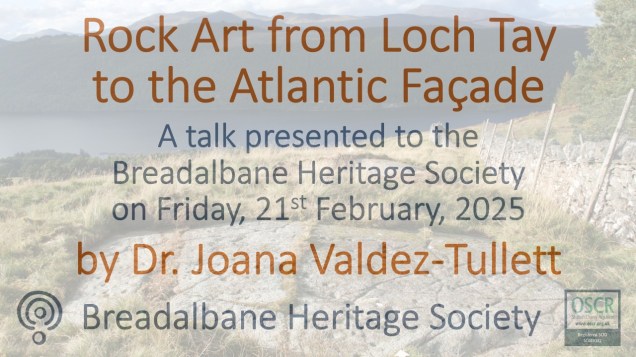
Prehistoric rock art in Scotland is mostly known for its cupmarks, cup-and-rings and other circular imagery. These motifs were typically carved on boulders and outcrops in the open landscape. Although we may not know what each of these symbols meant, recent research has suggested that this rock art tradition had a very important role in people’s lives during the Neolithic and Early Bronze Age periods. In this talk Dr. Joana Valdez-Tullett discussed the results of Scotland’s Rock Art Project research in Loch Tay, and how carvings in this region relate to other areas in Scotland and the wider Atlantic façade. Watch here: ‘From Loch Tay to the Atlantic Façade‘

John started his talk with a short introduction on the history of Cluny and its gardens, and how it has developed and the future. Spring is a glorious time at Cluny with carpets of North American bulbs and tubers in April while May brings colourful Candelabra primulas and wonderful blue Himalayan poppies. Watch here: ‘Cluny Gardens in the Spring’
2025-26 Season
Invasive Non-Native Species (INNS) are a significant threat to our environments, our native wildlife, our economy, and in some cases to our health. The Scottish Invasive Species Initiative (SISI) is a project set up to tackle invasive non-native species alongside rivers and watercourses in northern Scotland. Mark Purrman-Charles, from SISI, will talk about the work SISI has done within the Esk & Tay catchment area and how invasive plants, particularly Giant Hogweed and Japanese Knotweed have been controlled so successfully within the Upper Tay area. Watch here: ‘Strategic Control of Invasive Non-Native Species in a River System’
The transformation of Aberfeldy from a few hovels to the smart town we know today, took place during the industrial revolution and was profoundly influenced by it. Alan Fisher, whose family has a history in the town spanning over 200 years, discussed Aberfeldy’s development with particular focus on the history of its wool, whisky and laundry industries. Watch here: ‘Aberfeldy’s Industrial Revolution’
Chris Fleet, Map Curator at the National Library for Scotland, examined selected maps of Perthshire and Breadalbane over the last four centuries, looking at who made these maps, why, and who they made them for. Over the centuries, different purposes including state integration, military conquest, agricultural improvement, and improving communications resulted in very different maps. A particular focus was also on how particular map-makers gathered their information, and how this resulted in very different maps. Watch here: ‘The Mapping of Perthshire and Breadalbane through the Ages’
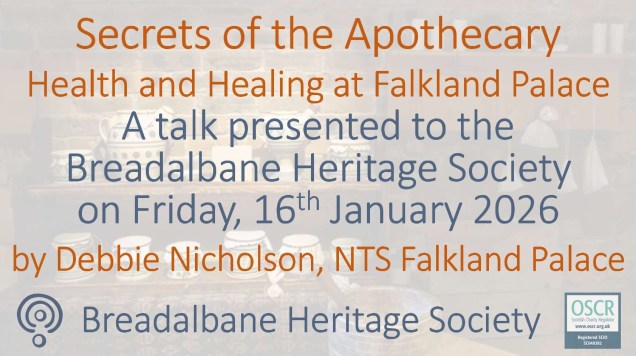
In 2018, Falkland Palace installed a reproduction Apothecary in one of their cellar rooms. The purpose was to allow them to talk about the way medicine was understood and practised in the late 16th century, when King James VI was frequently in residence with an entourage including his Royally appointed medical men. This talk took a closer look at the Royal Apothecaries – who they were, how they understood health and medicine and what their practice looked like. Watch here: ‘Secrets of the Apothecary: Health and Healing at Falkland Palace’

In this talk Professor Gordon Noble outlined the latest progress on work on the Southern Pictish Kingdoms. The Picts – ‘the painted people’ – were first mentioned in late Roman sources in AD 297 as a collective name for troublesome, barbaric peoples, living north of the Roman frontier. The Picts went on to become the dominant kingdom in northern Britain, forming the precursor to the medieval kingdom of Alba and latterly of Scotland. The Picts have long remained an enigma due to the dearth of historical sources they left behind, and the archaeological record has been very difficult to populate too. This talk focused on some recent discoveries at sites such as East Lomond, Fife and also outlined the significance of the Pictish site of Fortingall. Watch here: ‘The Southern Pictish Kingdoms incluing Fortingall‘
 Breadalbane Heritage Society
You must be logged in to post a comment.