Our winter season of six talks begins in September and runs through to March on the third Friday of the month, apart from December when there is not a talk. With the exception of the January and February talks which are presented only online on Zoom, the other talks are held in the main hall of the Breadalbane Community Campus in Aberfeldy at 7.30 p.m.
For further information about our talks, past and present, go to our Events page or contact Ian at bhsaberfeldy@gmail.com.
Stefan Sagrott, HES Senior Cultural Resources Advisor is responsible for all the Historic Environment Scotland properties in Dumfries and Galloway, and presented an illustrated talk on the abbeys and castles, amongst other properties, predominantly in the Galloway area.
Stefan has worked with Historic Environment Scotland for over 8 years and, since September 2021, he is the Senior Cultural Resources Advisors (South). His work contributes towards developing greater understanding of, and the management and conservation of, the HES estate and its cultural significance.
He is a member of the HES Cultural Resources Team , and of the Cultural Assets Directorate. His job necessitates him having a broad range of research interests across many periods and he provides specialist heritage advice relating to the Properties in Care (PIC).
The October talk by Colin Liddell on ‘The Military Bridges of Wade and Caulfeild’ and the April talk by John Mattingley on ‘Cluny Gardens in the Spring’ were recorded and can now be viewed below.
Colin Liddell who in the past has presented talks on General Wade’s Scottish roads, concentrates this time on the bridges constructed by General Wade and his successor, Major William Caulfeild, who supervised the construction of many more roads and bridges than Wade.
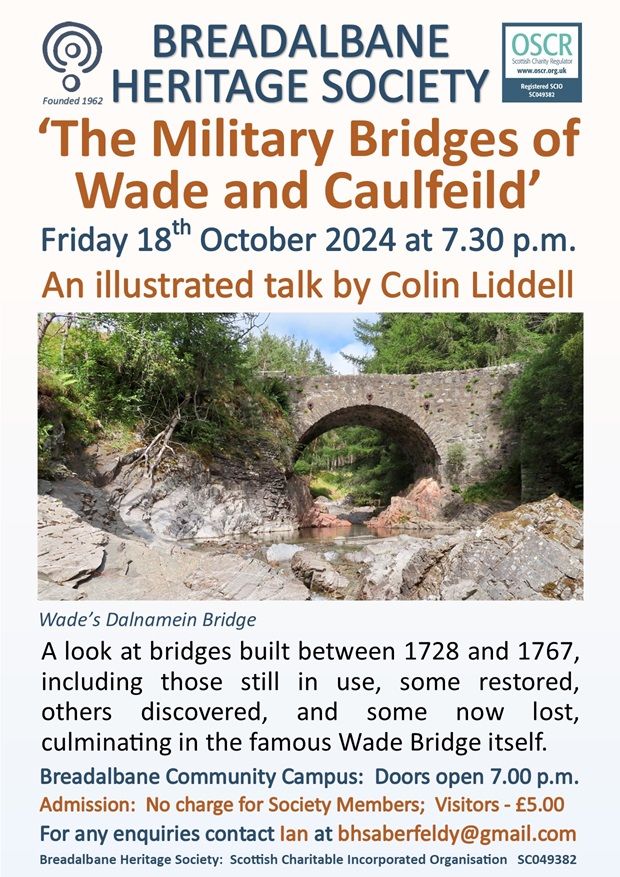
The talk looks at military bridges built between 1726 and 1767, constructed by Major-General George Wade MP, “Commander of Forces in Northern Britain”, and Major William Caulfeild, Chief Engineer, later “Inspector of Roads in Scotland”, including those bridges still in use, some restored, others discovered, and some now lost, culminating in the famous ‘Wade Bridge’ itself in Aberfeldy. Watch here: ‘The Military Bridges of Wade and Caulfeild’
John started his talk with a short introduction on the history of Cluny and its gardens, and how it has developed and the future.
Spring is a glorious time at Cluny with carpets of North American bulbs and tubers in April while May brings colourful Candelabra primulas and wonderful blue Himalayan poppies. Watch here:https://vimeo.com/manage/videos/1083524454
Digging in the Archives for Margaret E C Stewart:The Contribution of Women to Scottish Archaeology in the Twentieth Century
Amy Jo Kearton, a graduate in History from the University of Glasgow in 2024, undertook research as part of her Honours’ degree dissertation aimed to help locate women within the history of Scottish archaeology and focused on Margaret Stewart because her archaeological career represented the wider achievements of female archaeologists in twentieth-century Scotland.
From her extensive research for her dissertation, Amy Jo recently wrote a summary profile of Margaret in which she explored the process of excavating Margaret from historical records and then delved into Margaret’s involvement with the Breadalbane Heritage Society.
This was presented and uploaded as a blog on our website in December 2024.
As the blog attracted a lot of interest, Amy Jo consented to us publishing her full dissertation on our website, and here is an introductory extract from the dissertation:
Overall, this life history of Margaret aims to assess the place of individual women in Scottish archaeology.
Chapter One considers Margaret’s motivations to pursue archaeology and her education under Gordon Childe at the University of Edinburgh.
The second chapter delves into Margaret’s career using representative examples to understand how she became a respected archaeologist.
The final chapter examines Margaret’s public and administrative work within numerous societies.
By integrating the different strands of her personal and professional life, this dissertation demonstrates how Margaret navigated the field and constructed an accomplished career. In doing so, Margaret is positioned within the disciplinary history of Scottish archaeology and a wider circle of female archaeologists.
Therefore, Margaret’s achievements in Scottish archaeology can be celebrated alongside those of women throughout the twentieth century.
Our next winter talk, ‘Rock Art from Loch Tay to the Atlantic Façade’ will be presented only on Zoom by Dr. Joana Valdez-Tullett on Friday, 21st February, at 7.30 p.m., and we invite you to attend this free talk.
Joana is a Technical Specialist at Wessex Archaeology and a part-time teacher at Durham University. She was a Post-doctoral Research Assistant for almost five years with the Scottish Rock Art Project and has wide experience in rock art research of various periods, including Palaeolithic Art. She has been studying and investigating rock art from a number of western European countries (Portugal, Spain, Britain and Ireland) since 2003.
Recent research has suggested that the rock art tradition had a very important role in people’s lives during the Neolithic and Early Bronze Age periods. Joana will discuss results of the research from the Scotland Rock Art Project in Loch Tay, and how carvings in this region relate to other areas in Scotland and the wider Atlantic façade.
If you wish more information on, or want to register for, this talk, please contact Ian at bhsaberfeldy@gmail.com and he will send you the Zoom link.
Our next winter talk, ‘Abbeys and Castles of Dumfries and Galloway’ will be presented only on Zoom by Stefan Sagrott on Friday, 17th January, at 7.30 p.m., and we invite you to attend this free talk. Stefan is the Historic Environment Scotland’s Senior Cultural Resources Advisor (South) and is responsible for all the HES properties in Dumfries and Galloway.
If you wish more information on or want to register for this talk, please contact Ian at bhsaberfeldy@gmail.com and he will send you the Zoom link for this talk.
Our February talk, ‘Rock Art from Loch Tay to the Atlantic Façade’, will also be presented only on Zoom and we will publish more information on this talk in due course.
Margaret Stewart at the Carse Farm excavation, 1964
In 1962, Dr. Margaret Enid Crichton Stewart who played a central role in community archaeology in Perthshire, was instrumental in encouraging the formation of the present-day Breadalbane Heritage Society.
Amy Jo Kearton, a recent graduate in History from the University of Glasgow, undertook research as part of her Honours’ degree dissertation aiming to help locate women within the history of Scottish archaeology. She focused on Margaret Stewart because her archaeological career represented the wider achievements of female archaeologists in twentieth-century Scotland.
The next BHS Winter Talk takes place in the Assembly Hall at the Breadalbane Community Campus at 7.30 p.m. on Friday 15th November, when Keith Myres will be talking about “Ardtrasgairt: A portait of a highland community in the 19th century”,but this will be preceded in the hall by the Annual Members’ Meeting (AMM) at 7.15 p.m..
At the AMM, there will be reports on the activities of the Breadalbane Heritage Society during the 2023-24 season, and the receiving of the Annual Accounts for the period 1st September 2023 to 31st August 2024 will be presented.
Depending on the length of the AMM, there may be a short break before the start of Keith’s Ardtrasgairt talk at 7.30 p.m..
Our next winter talk will be held on Friday, 18th October, in the Aberfeldy Breadalbane Community Campus, commencing at 7.30 p.m. This talk will be presented by Colin Liddell who in the past has presented talks on General Wade’s Scottish roads, but this time Colin will concentrate on the bridges constructed by General Wade and his successor, Major William Caulfeild, who supervised the construction of many more roads and bridges than Wade.
On Friday, 20th September, at 7.30 p.m., we start the new 2024-25 Winter Season of BHS Talks with presentations by interior decorators John and Mark Nevin who will will explain the meticulous and tough work they carried out to return the Castle to its former glory. This will be followed by Gordon MacGregor, Heraldry and Genealogy Expert, who will explain how the family’s history has shaped the interior symbolism and artwork and will describe in particular the significance of details within the public rooms.






You must be logged in to post a comment.